
Read the passage carefully and answer the Questions.
Alcohols and phenols are obtained when a hydrogen atom in aliphatic and aromatic hydrocarbons respectively, is replaced by - OH group. These compounds find wide applications in industry as well as in our daily life. You may notice that ordinary spirit is used for polishing wooden furniture which is chiefly a compound containing hydroxyl group. An alcohol contains one or more hydroxyl (OH) group(s) directly attached to carbon atom(s), of an aliphatic system (\( CH_3OH \)) while a phenol contains -OH group(s) directly attached to carbon atom(s) of an aromatic system (\( C_6H_5OH \)). Alcohols are prepared by the hydration of alkenes, fermentation of glucose, and reduction of carbonyl compounds. Alcohols produce alkenes upon dehydration whereas alkenes on acid catalyzed hydration convert into alcohols.
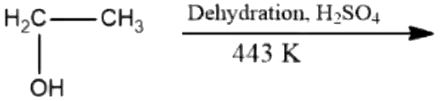
Product of the following reaction is
Answer & explanation
Correct answer: option 2
The correct answer is Option (2) → ethene (\( \ce{H2C=CH2} \))
Alcohols lose a molecule of water when heated with a protic acid such as concentrated sulphuric acid. The temperature decides the product: at the higher temperature one molecule of alcohol loses water internally and gives an alkene; at a lower temperature, with excess alcohol, two molecules lose one water molecule between them and give an ether.
The reactant drawn is ethanol, \( \ce{CH3CH2OH} \). At 443 K the –OH group and an H atom from the neighbouring carbon are removed together, and a C=C double bond forms:
\( \displaystyle \ce{CH3CH2OH} \xrightarrow[\text{443 K}]{\text{conc. }\ce{H2SO4}} \ce{CH2=CH2 + H2O} \)
So the product is ethene. (At 413 K the same reagents give ethoxyethane, \( \ce{C2H5-O-C2H5} \).)
Why the other options are incorrect
Option (1) prop-1-en-2-ol (\( \ce{CH3-C(OH)=CH2} \)) — Incorrect. It has three carbon atoms and still carries an –OH group; dehydration of a two-carbon alcohol can neither add a carbon nor keep the –OH group.
Option (3) ethene-1,2-diol (\( \ce{HO-CH=CH-OH} \)) — Incorrect. It has two –OH groups, while dehydration removes the one –OH group that ethanol has.
Option (4) prop-2-en-1-ol (\( \ce{HO-CH2-CH=CH2} \)) — Incorrect. This is allyl alcohol, a three-carbon alcohol; it is not obtained from ethanol.
NCERT (2026-27 edition):
Preparation of Ethers – …
