Read the following case study and answer questions.
Company X raised ₹10,00,000 through issue of shares in open market to raise funds to establish the business of selling electronic goods. Later on for procuring funds for next six months, Company X was dependent on sources like commercial paper, and commercial bill. The issue of share done in open market was oversubscribed due to good reputation of company. These sources help the company to mobilise a large amount of money for long as well as short run. The business succeeded in its operations using these funds.
Certificate of deposits are:
Answer & explanation
Correct answer: option 4
The correct answer is Option (4) → Negotiable instruments
Option (1) Promissory Note — Incorrect. The term “promissory note” is used for commercial paper, not for a CD.
Option (2) Bills payable — Incorrect. Bills payable is an accounting term for bills a firm has to pay. It is not how a CD is described.
Option (3) Bills Receivable — Incorrect. Bills receivable is an accounting term for bills a firm will receive money on. It is not a description of a CD.
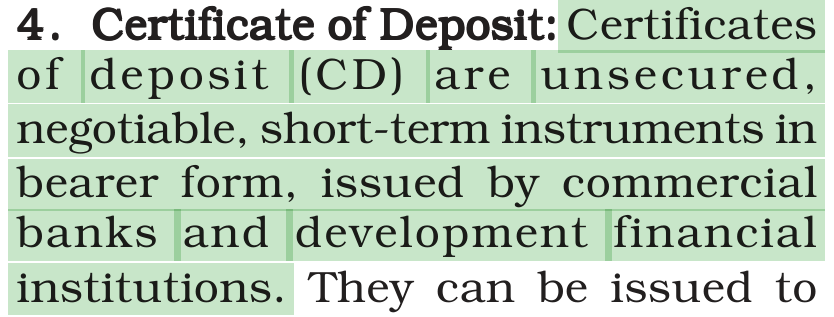
Option (4) Negotiable instruments — Correct. Certificates of deposit (CD) are unsecured, negotiable, short-term instruments in bearer form, issued by commercial banks and development financial institutions. “Negotiable” means the holder can transfer the CD to another person, who then gets the right to receive the money.
Note: Although the chapter ‘Financial Markets’ was dropped from the NCERT textbooks during rationalisation, it has stayed in the NTA syllabus every year since 2022, except for 2025, and it is part of the syllabus again from 2026. This question is therefore based on the pre-rationalised NCERT, an extract from which is given below. NCERT (Pre-rationalised Edition):
|