CUETMOCK
  • Pricing
  • Mentors
Log inStart freeStart free mocks→

First test, then trust

Try a free CUET mock test.

Join 5,00,000+ students who rehearsed exam day on the exact NTA screen before sitting CUET. On the web and on Android.

Start free mocks →Get the Android app
CUETMOCK

India's #1 CUET Mock Test Platform. Original NCERT-based questions on the exact NTA exam screen — trusted by 5,00,000+ students since CUET 2022.

Get it onGoogle PlayScan to download the CUETMOCK app

Mock tests

  • CUET mock test series
  • Commerce mocks
  • Humanities (Arts) mocks
  • Science mocks
  • Languages & GAT mocks
  • Free practice questions
  • Pricing

Resources

  • CUET exam guide
  • CUET syllabus
  • Universities accepting CUET
  • Expert blogs
  • News & notifications
  • Webinars & counselling
  • CUET score calculator
  • How we estimate your rank
  • FAQs

Company

  • About us
  • Our leadership & team
  • Our toppers
  • Mentors
  • For schools
  • Contact us
  • Terms
  • Privacy
  • Refund policy

Talk to us

+91 7696 6630 56info@cuetmock.comWhatsApp us

Our other platforms

  • JEE Mock — For IIT-JEE aspirants
  • NEET Mock — For NEET aspirants

Newsletter

Exam updates, study material and offers — no spam.

© 2026 NYC Ventures Pvt. Ltd.

701-702, Royal Business Park, Zirakpur, Punjab - 140603

  • Terms of use
  • Privacy policy
  • Refund policy
  • Contact us

iCUETMOCK is an independent preparation platform, not affiliated with the National Testing Agency (NTA). Always check exam details on the official NTA website.

  • Home
  • Mock tests
  • CUET guide
  • Pricing
  • Log in
Home/Practice questions/History
HistoryMedieval India: Bhakti Sufi Traditions

Who was the first Sultan to visit the dargah of Khwaja Muinuddin?

Who was the first Sultan to visit the dargah of Khwaja Muinuddin?

Answer & explanation+

Correct answer: option 1

The correct answer is Option (1) → Muhammad bin Tughlaq

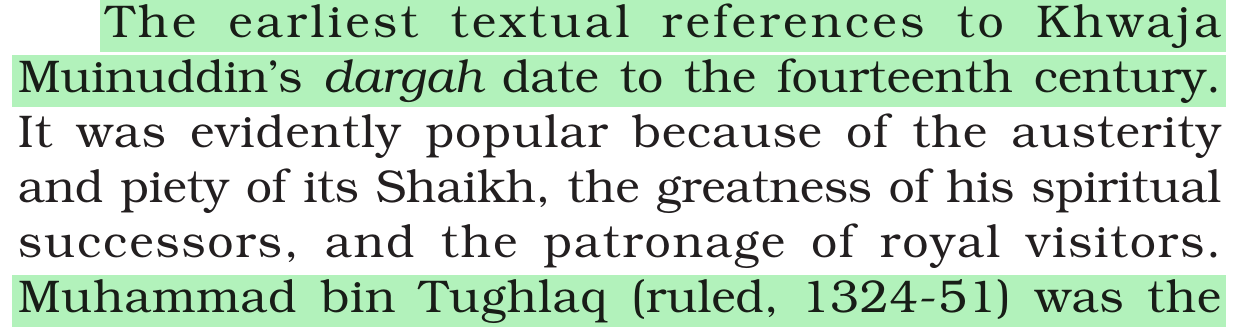
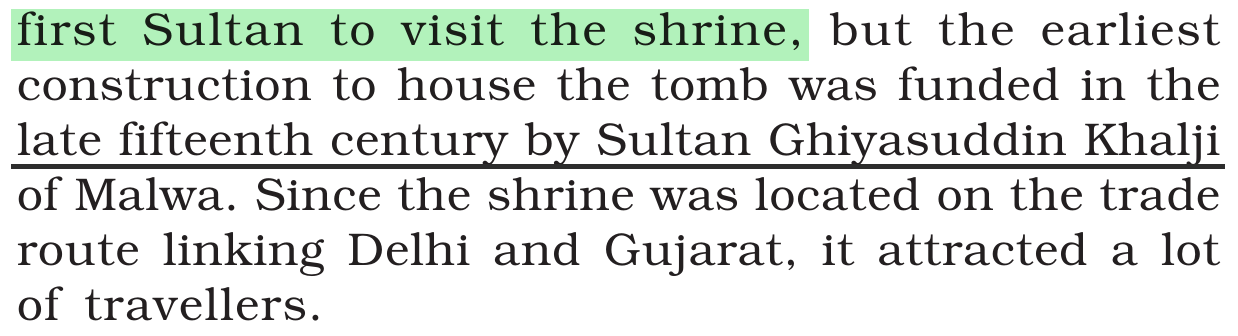
Muhammad bin Tughlaq (ruled 1324-51) was the first Sultan to visit the shrine of Khwaja Muinuddin at Ajmer.


NCERT: Themes in Indian History Part II — Chapter 6: Bhakti-Sufi Traditions (2026-27)

NCERT extractNCERT extract

Advertisement

Practise more on Medieval India: Bhakti Sufi Traditions

Chapter-wise mocks on the real NTA exam screen, with solutions and your rank. Your first mocks are free.

Start free mocks →

Advertisement

Next questions

  1. Match List-I (situation) with List-II (concept from Rogers' theory).List-IList-II(A) Meera often pictures the confident public speaker she…Psychology · Self and Personality
  2. Rearrange the sentences in correct sequence: (A) People constantly complain about bad memory. (B) A memory trainer meets people from differ…English · Comprehension - (Narrative / Factual)
  3. If cos B , sin B, cot B are in geometric progression, then the value of tan6B - tan2 B is?General Aptitude Test · Quantitative Reasoning
  4. Among the following statements on the nitration of aromatic compounds, the false one is:Chemistry · Organic: Amines
  5. What happens to a consumer’s demand for low quality food items like coarse cereals when her income rises beyond a low level?Economics · Micro Economics: Theory of Consumer behaviour
  6. The settlement of Chanhudaro was a centre of:History · Ancient India: Bricks, Beads and Bones
  7. If a + b + c = 19, ab + bc + ca = 120, then what is the value of a^3 + b^3 + c^3 - 3abc?General Aptitude Test · Quantitative Reasoning
  8. "The power of population is so superior to the power of the earth to produce subsistence for man, that premature death must in some shape o…Sociology · Indian Society: Demographic Structure of Indian Society
  9. A box contains 6 nails and 10 nuts. Half of the nails and half of the nuts are rusted. If one item is chosen at random, what is the probabi…Maths. Section A · Probability
  10. Select the word opposite in meaning to the given word:- EnervatedEnglish · Antonyms