
In the circuit diagram shown in the figure, the potential difference E is 20 V.
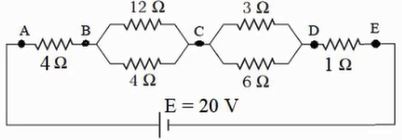
(A) The potential difference across points C and D is $V_{CD}$
(B) The potential difference across points B and C is $V_{BC}$
(C) The potential difference across points D and E is $V_{DE}$
(D) The potential difference across points A and B is $V_{AB}$
If the potentials $V_{AB}, V_{BC}, V_{CD}, V_{DE}$ are arranged in increasing order, then
Choose the correct answer from the options given below:
Answer & explanation
Correct answer: option 1
The correct answer is Option (1) → (C), (A), (B), (D)
Given: $E = 20\,\text{V}$
Resistances: $R_{AB}=4\,\Omega,\; R_{\text{top (B–C)}}=12\,\Omega,\; R_{\text{bot (B–C)}}=4\,\Omega,\; R_{\text{top (C–D)}}=3\,\Omega,\; R_{\text{bot (C–D)}}=6\,\Omega,\; R_{DE}=1\,\Omega$
Equivalent resistance between B and C:
$R_{BC}=\frac{12\times4}{12+4}=\frac{48}{16}=3\,\Omega$
Equivalent resistance between C and D:
$R_{CD}=\frac{3\times6}{3+6}=\frac{18}{9}=2\,\Omega$
Total series resistance:
$R_{\text{tot}}=R_{AB}+R_{BC}+R_{CD}+R_{DE}=4+3+2+1=10\,\Omega$
Current through the circuit:
$I=\frac{E}{R_{\text{tot}}}=\frac{20}{10}=2\,\text{A}$
Potential differences:
$V_{AB}=I\,R_{AB}=2\times4=8\,\text{V}$
$V_{BC}=I\,R_{BC}=2\times3=6\,\text{V}$
$V_{CD}=I\,R_{CD}=2\times2=4\,\text{V}$
$V_{DE}=I\,R_{DE}=2\times1=2\,\text{V}$
Increasing order:
$V_{DE} , V_{CD} , V_{BC} , V_{AB}$