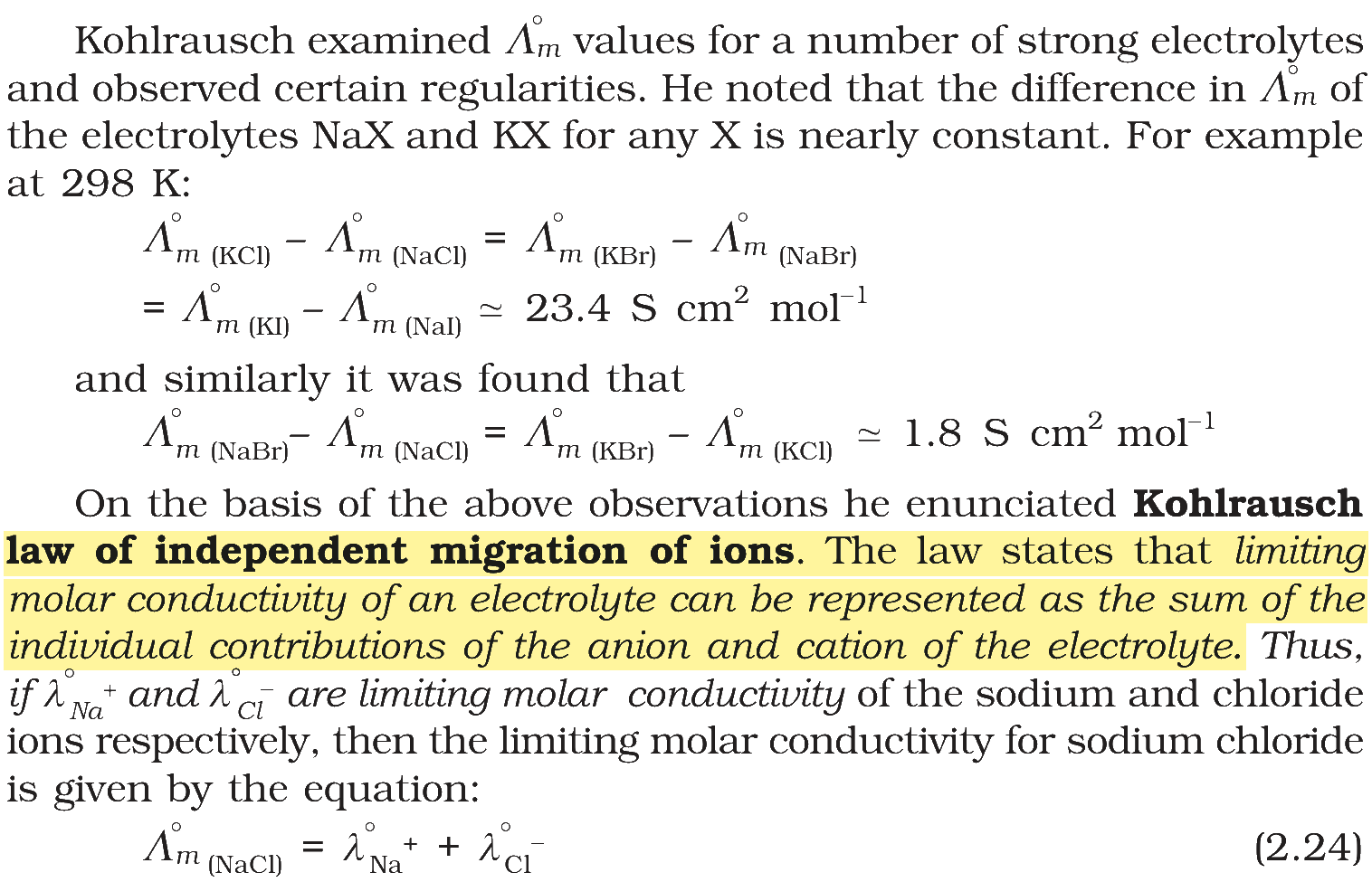
The molar conductivity of \( \text{KNO}_3\text{, NaCl and KCl} \) are 111, 128 and \( 152\text{ S cm}^2\text{ mol}^{-1} \), respectively. The molar conductivity of \( \text{NaNO}_3 \) will be:
Answer & explanation
Correct answer: option 4
The correct answer is Option (4) → \( 87\ \text{S}\ \text{cm}^2\ \text{mol}^{-1} \)
By Kohlrausch’s law of independent migration of ions, the limiting molar conductivity of an electrolyte is the sum of the contributions of its cation and its anion. (The values given are taken as limiting values, at infinite dilution.)
\( \displaystyle \Lambda^{\circ}_m(\ce{NaNO3}) = \lambda^{\circ}_{\ce{Na+}} + \lambda^{\circ}_{\ce{NO3^-}} \)
The ions \( \ce{Na+} \) and \( \ce{NO3^-} \) come from different given salts, so the three values are combined in such a way that the unwanted ions, \( \ce{K+} \) and \( \ce{Cl^-} \), cancel:
\( \displaystyle \Lambda^{\circ}_m(\ce{KNO3}) + \Lambda^{\circ}_m(\ce{NaCl}) - \Lambda^{\circ}_m(\ce{KCl}) = (\lambda^{\circ}_{\ce{K+}} + \lambda^{\circ}_{\ce{NO3^-}}) + (\lambda^{\circ}_{\ce{Na+}} + \lambda^{\circ}_{\ce{Cl^-}}) - (\lambda^{\circ}_{\ce{K+}} + \lambda^{\circ}_{\ce{Cl^-}}) \)
\( \displaystyle = \lambda^{\circ}_{\ce{Na+}} + \lambda^{\circ}_{\ce{NO3^-}} = \Lambda^{\circ}_m(\ce{NaNO3}) \)
Substituting the values:
\( \displaystyle \Lambda^{\circ}_m(\ce{NaNO3}) = 111 + 128 - 152 = 87\ \mathrm{S\,cm^{2}\,mol^{-1}} \)
So the molar conductivity of \( \ce{NaNO3} \) is 87 S cm2 mol−1.
NCERT (2026-27 edition):
Variation of Conductivity and Molar Conductivity with Concentration – …