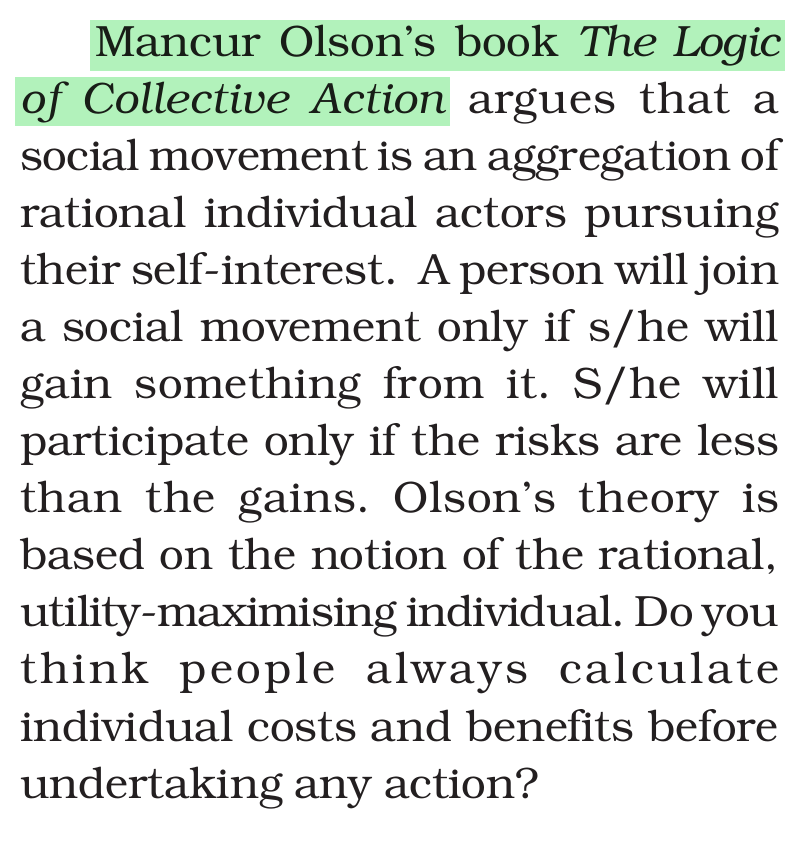
Match the book in List - I with the author in List - II.
| LIST-I (Book) | LIST-II (Author) | ||
| (A) | The Logic of Collective Action | (I) | Gail Omvedt |
| (B) | Reinventing Revolution | (II) | Ramachandra Guha |
| (C) | Unquiet Woods | (III) | Ghanshyam Shah |
| (D) | Social Movements and the State | (IV) | Mancur Olson |
Choose the correct answer from the options given below:
Answer & explanation
Correct answer: option 4
The correct answer is Option (4) → (A)-(IV), (B)-(I), (C)-(II), (D)-(III)
(A) The Logic of Collective Action — this matches (IV) Mancur Olson.
(B) Reinventing Revolution — this matches (I) Gail Omvedt.
(C) Unquiet Woods — this matches (II) Ramachandra Guha.
(D) Social Movements and the State — this matches (III) Ghanshyam Shah.
Note: The lines on Mancur Olson’s book The Logic of Collective Action, in the part on theories of social movements, and on Gail Omvedt’s book Reinventing Revolution, in the section on old and new social movements in the Indian context, were there in the chapter ‘Social Movements’ of the pre-rationalised NCERT, which NTA followed in 2023. These portions have been deleted from the NCERT book (2025-26), though the chapter is still there with Guha’s Unquiet Woods and Shah’s Social Movements and the State.
NCERT (2025-26): “8.4 Ecological Movements … According to Ramachandra Guha in his book, Unquiet Woods, villagers rallied together to save the oak and rhododendron forests near their villages.…” NCERT (Pre-rationalised): “…Gail Omvedt in her book Reinventing Revolution points out that concerns about social inequality and the unequal distribution of resources continue to be important elements in these movements. Peasant movements have mobilised for better prices for their produce and protested against the removal of agricultural subsidies.…”
References, chapter ‘Social Movements’ (NCERT 2025-26)
Margin box on Mancur Olson (Pre-rationalised NCERT) |