
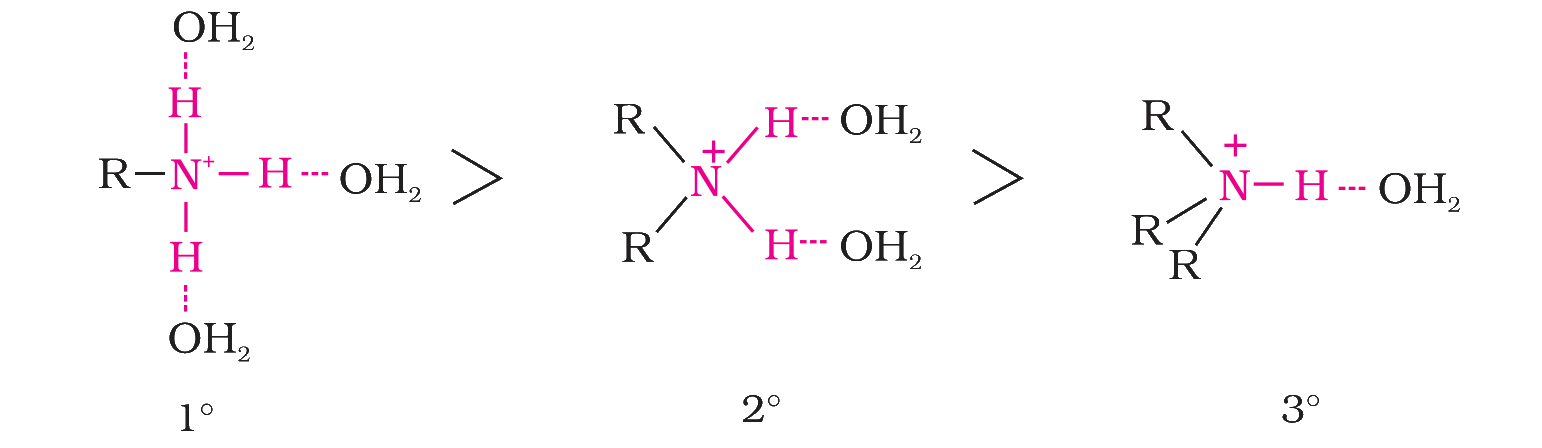
The figure shows the substituted ammonium ions of primary (1°), secondary (2°) and tertiary (3°) amines in water (R = alkyl group).
According to the figure, why is the ion of a primary amine stabilised more by solvation than the ion of a tertiary amine?
Answer & explanation
Correct answer: option 1
The correct answer is Option (1) → It forms three hydrogen bonds with water molecules, while the ion of the tertiary amine forms one.
In the figure each N–H hydrogen of an ion forms one hydrogen bond with a water molecule (the dotted lines). The 1° ion, \( \ce{RNH3+} \), has three such bonds, the 2° ion two and the 3° ion, \( \ce{R3NH+} \), only one.
More hydrogen bonding with water means more solvation, so the 1° ion is stabilised most. The bigger 3° ion, with three R groups, is solvated least.
Why the other options are incorrect
Option (2) Its nitrogen atom carries a larger positive charge than the nitrogen of the ion of the tertiary amine. — Incorrect. Each ion carries a single positive charge on nitrogen; the charge is the same in all three.
Option (3) Its alkyl group releases more electrons to nitrogen than the three alkyl groups of the ion of the tertiary amine. — Incorrect. The +I effect grows with the number of alkyl groups, so it is larger in the tertiary ion; it would favour the tertiary ion, not the primary ion.
Option (4) It forms hydrogen bonds with water through an unshared electron pair on its nitrogen atom. — Incorrect. In the ion all four orbitals of nitrogen are used for bonds, so there is no unshared pair; the hydrogen bonds are formed through the N–H hydrogens.
NCERT (2026-27 edition):
9.6 Chemical Reactions – “In the aqueous phase, the substituted ammonium cations get stabilised not only by electron releasing effect of the alkyl group (+I) but also by solvation with water molecules. The greater the size of the ion, lesser will be the solvation and the less stabilised is the ion. The order of stability of ions are as follows:”
Decreasing order of extent of H-bonding in water and order of stability of ions by solvation.