
CUETMOCK
  • Pricing
  • Mentors
Log inStart freeStart free mocks→

First test, then trust

Try a free CUET mock test.

Join 5,00,000+ students who rehearsed exam day on the exact NTA screen before sitting CUET. On the web and on Android.

Start free mocks →Get the Android app
CUETMOCK

India's #1 CUET Mock Test Platform. Original NCERT-based questions on the exact NTA exam screen — trusted by 5,00,000+ students since CUET 2022.

Get it onGoogle PlayScan to download the CUETMOCK app

Mock tests

  • CUET mock test series
  • Commerce mocks
  • Humanities (Arts) mocks
  • Science mocks
  • Languages & GAT mocks
  • Free practice questions
  • Pricing

Resources

  • CUET exam guide
  • CUET syllabus
  • Universities accepting CUET
  • Expert blogs
  • News & notifications
  • Webinars & counselling
  • CUET score calculator
  • How we estimate your rank
  • FAQs

Company

  • About us
  • Our leadership & team
  • Our toppers
  • Mentors
  • For schools
  • Contact us
  • Terms
  • Privacy
  • Refund policy

Talk to us

+91 7696 6630 56info@cuetmock.comWhatsApp us

Our other platforms

  • JEE Mock — For IIT-JEE aspirants
  • NEET Mock — For NEET aspirants

Newsletter

Exam updates, study material and offers — no spam.

© 2026 NYC Ventures Pvt. Ltd.

701-702, Royal Business Park, Zirakpur, Punjab - 140603

  • Terms of use
  • Privacy policy
  • Refund policy
  • Contact us

iCUETMOCK is an independent preparation platform, not affiliated with the National Testing Agency (NTA). Always check exam details on the official NTA website.

  • Home
  • Mock tests
  • CUET guide
  • Pricing
  • Log in
Home/Practice questions/Chemistry
ChemistryOrganic: Amines

What will be the major product of the given reaction sequence?
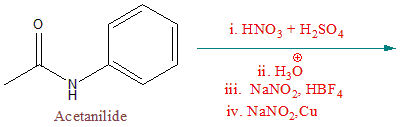
What will be the major product of the given reaction sequence?

Answer & explanation+

Correct answer: option 4

The correct answer is Option (4) → p-Dinitrobenzene

The acetylated –NH2 group steers the first nitro group to the para position; the –NH2 group is then freed, turned into a diazonium group and replaced by a second –NO2 group.

  • (i) Nitration: the –NHCOCH3 group directs to the ortho and para positions, and the p-nitro derivative is the major product (p-nitroacetanilide).

        \( \displaystyle \ce{C6H5NHCOCH3 + HNO3} \xrightarrow{\ce{H2SO4}} \ce{O2N-C6H4-NHCOCH3 + H2O} \)

  • (ii) \( \ce{H3O+} \): hydrolysis of the amide removes the acetyl group and gives p-nitroaniline.

        \( \displaystyle \ce{O2N-C6H4-NHCOCH3 + H2O} \xrightarrow{\ce{H3O+}} \ce{O2N-C6H4-NH2 + CH3COOH} \)

  • (iii) \( \ce{NaNO2} \), \( \ce{HBF4} \): sodium nitrite and the acid give nitrous acid in the mixture; this diazotises the –NH2 group in the cold, and with fluoroboric acid present the diazonium salt is precipitated as p-nitrobenzenediazonium fluoroborate.

        \( \displaystyle \ce{NaNO2 + HBF4 -> HNO2 + NaBF4} \)

        \( \displaystyle \ce{O2N-C6H4-NH2 + HNO2 + HBF4} \xrightarrow{\text{273-278 K}} \ce{O2N-C6H4-N2^+BF4^- v + 2H2O} \)

  • (iv) \( \ce{NaNO2} \), Cu: heating the diazonium fluoroborate with aqueous sodium nitrite and copper replaces the diazonium group by –NO2, with loss of nitrogen gas.

        \( \displaystyle \ce{O2N-C6H4-N2^+BF4^- + NaNO2} \xrightarrow[\Delta]{\ce{Cu}} \ce{O2N-C6H4-NO2 + N2 ^ + NaBF4} \)

The second –NO2 group takes the place of the old –NH2 group, para to the first: p-dinitrobenzene.

Why the other options are incorrect

Option (1) p-Nitroaniline — Incorrect. It is the product of step (ii) only; steps (iii) and (iv) replace its –NH2 group.

Option (2) p-Nitroacetanilide — Incorrect. It is formed in step (i) and is hydrolysed in step (ii).

Option (3) m-Dinitrobenzene — Incorrect. The first nitro group enters para to the nitrogen, and the second takes the nitrogen’s own place, so the two groups end up para, not meta.

NCERT (2026-27 edition):
9.6 Chemical Reactions – “However, by protecting the –NH2 group by acetylation reaction with acetic anhydride, the nitration reaction can be controlled and the p-nitro derivative can be obtained as the major product.”
“… This can be done by protecting the -NH2 group by acetylation with acetic anhydride, then carrying out the desired substitution followed by hydrolysis of the substituted amide to the substituted amine.”

9.7 Method of Preparation of Diazonium Salts – “Benzenediazonium chloride is prepared by the reaction of aniline with nitrous acid at 273-278K. … The conversion of primary aromatic amines into diazonium salts is known as diazotisation.”

9.9 Chemical Reactions – “3. Replacement by fluoride ion: When arenediazonium chloride is treated with fluoroboric acid, arene diazonium fluoroborate is precipitated which on heating decomposes to yield aryl fluoride.”
“6. Replacement by –NO2 group: When diazonium fluoroborate is heated with aqueous sodium nitrite solution in the presence of copper, the diazonium group is replaced by –NO2 group.”

Advertisement

Practise more on Organic: Amines

Chapter-wise mocks on the real NTA exam screen, with solutions and your rank. Your first mocks are free.

Start free mocks →

Advertisement

Next questions

  1. A wire carries a current of 10 A in south to north direction. The magnetic field due to 1 cm piece of wire at a point 200 cm northeast from…Physics · Moving Charges and Magnetism
  2. Match List-I with List-IIList-IList-IIEnzymeFunction(A) Nuclease(I) Synthesizes DNA from RNA(B) Ligase(II) Have both directions exonuclease…Biology · Molecular Basis of Inheritance
  3. अवधी और ब्रज, दोनों भाषाओं में रचना करने वाले कवि हैं -Hindi · हिंदी साहित्य (रचना, रचनाकार और विधाएँ)
  4. In the late eighteenth century, the Santhals began to come into Bengal. Why did the zamindars hire them?History · Modern India: Colonialism and the Countryside
  5. Which of the following animals is NOT a reptile?English · Odd One Out
  6. Which of the following Indian institutes has established its International Campus in Zanzibar islands of East Africa in 2023?General Aptitude Test · Current Affairs
  7. In which year was the state of Nagaland created?Political Science · Politics in India Since Independence: Regional Aspirations
  8. A boy secures 70%, 40% and 60% marks in test papers with 100, 50 and 150 respectively as maximum marks. The percentage of his aggregate is:General Aptitude Test · Numerical Ability
  9. The question consists of a question and two statements numbered I and II given below it. You have to decide whether the data provided in th…General Aptitude Test · Verbal Reasoning
  10. A bag contains 100 balls numbered from 1 to 100. Four balls are removed at random with out replacement. The probability that the number on…Maths. Section B1 · Probability