
Assertion (A): In aqueous solution, (CH3)3N is a weaker base than CH3NH2.
Reason (R): On the basis of the +I effect of alkyl groups, the basic nature of aliphatic amines should increase with increase in the number of alkyl groups.
In the light of the above statements, choose the correct answer from the options given below:
Answer & explanation
Correct answer: option 2
The correct answer is Option (2) → Both (A) and (R) are true but (R) is not the correct explanation of (A).
Assertion (A): In aqueous solution, (CH3)3N is a weaker base than CH3NH2. — True. In water the order of basic strength of the methyl amines is \( \ce{(CH3)2NH} \gt \ce{CH3NH2} \gt \ce{(CH3)3N} \gt \ce{NH3} \).
Reason (R): On the basis of the +I effect of alkyl groups, the basic nature of aliphatic amines should increase with increase in the number of alkyl groups. — True. Alkyl groups push electrons towards nitrogen and make its unshared pair more available for a proton.
This expected order, tertiary > secondary > primary > NH3, is followed in the gaseous phase.
Why R does not explain A?
R would make (CH3)3N, with three methyl groups, a stronger base than CH3NH2, which is the opposite of A.
The correct reason for A is solvation: in water the cation (CH3)3NH+ has only one N–H hydrogen to form hydrogen bonds with water molecules, so it is the least stabilised by solvation, and trimethylamine is the weaker base.
NCERT (2026-27 edition):
9.6 Chemical Reactions – “Due to the electron releasing nature of alkyl group, it pushes electrons towards nitrogen and thus makes the unshared electron pair more available for sharing with the proton of the acid. … Thus, the basic nature of aliphatic amines should increase with increase in the number of alkyl groups. This trend is followed in the gaseous phase. … The trend is not regular in the aqueous state … In the aqueous phase, the substituted ammonium cations get stabilised not only by electron releasing effect of the alkyl group (+I) but also by solvation with water molecules. The greater the size of the ion, lesser will be the solvation and the less stabilised is the ion. The order of stability of ions are as follows:”
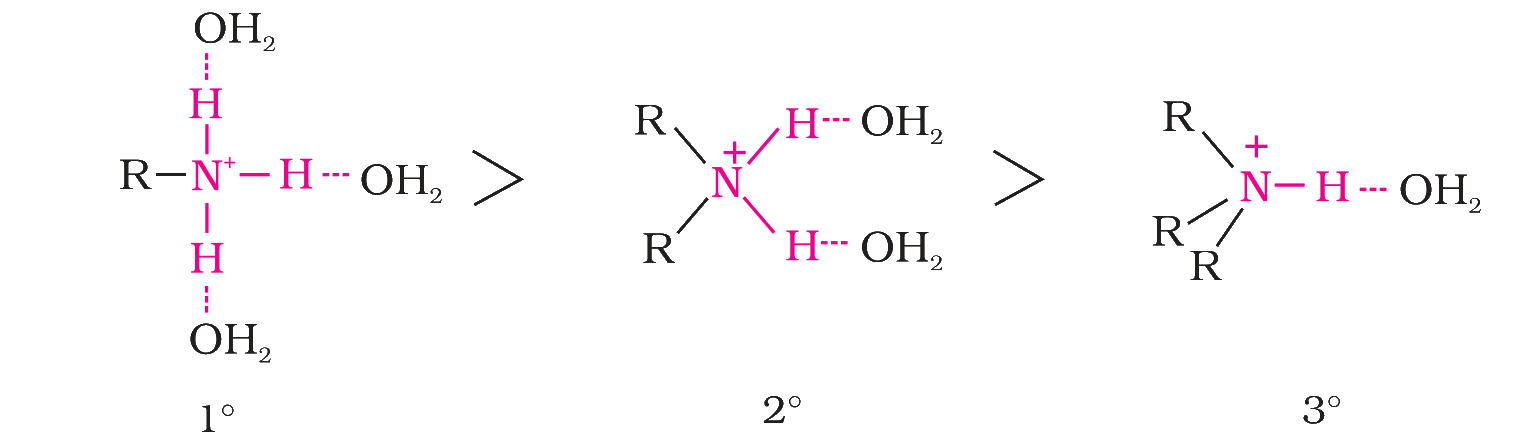
Decreasing order of extent of H-bonding in water and order of stability of ions by solvation.
“Greater is the stability of the substituted ammonium cation, stronger should be the corresponding amine as a base. … The order of basic strength in case of methyl substituted amines … in aqueous solution is as follows: … (CH3)2NH > CH3NH2 > (CH3)3N > NH3”