
Which of the following statements is correct about incomplete dominance?
Answer & explanation
Correct answer: option 2
The correct answer is Option (2) → In a monohybrid cross, F1 progeny resemble neither of the parents.
In incomplete dominance, neither allele is fully dominant over the other, so the heterozygote shows an in-between phenotype. In the snapdragon, a cross of red (RR) and white (rr) gives pink (Rr) F1 plants. In the F2, red, pink and white appear in the ratio 1 : 2 : 1.
Option (1) F2 phenotypic ratio will be different from F2 genotypic ratio. — Incorrect. The F2 genotypic ratio is 1 RR : 2 Rr : 1 rr, and the phenotypic ratio is 1 red : 2 pink : 1 white. Because each genotype has its own colour, the two ratios are the same. (In complete dominance they differ: 3 : 1 against 1 : 2 : 1.)
Option (2) In a monohybrid cross, F1 progeny resemble neither of the parents. — Correct. The F1 is pink, so it looks like neither the red nor the white parent. Its phenotype lies in between the two.
NCERT Extract:
Incomplete Dominance – “When experiments on peas were repeated using other traits in other plants, it was found that sometimes the F1 had a phenotype that did not resemble either of the two parents and was in between the two. The inheritance of flower colour in the dog flower (snapdragon or Antirrhinum sp.) is a good example to understand incomplete dominance. In a cross between true-breeding red-flowered (RR) and true-breeding white-flowered plants (rr), the F1 (Rr) was pink (Figure 4.6). When the F1 was self-pollinated the F2 resulted in the following ratio 1 (RR) Red: 2 (Rr) Pink: 1 (rr) White. Here the genotype ratios were exactly as we would expect in any mendelian monohybrid cross, but the phenotype ratios had changed from the 3:1 dominant : recessive ratio.”
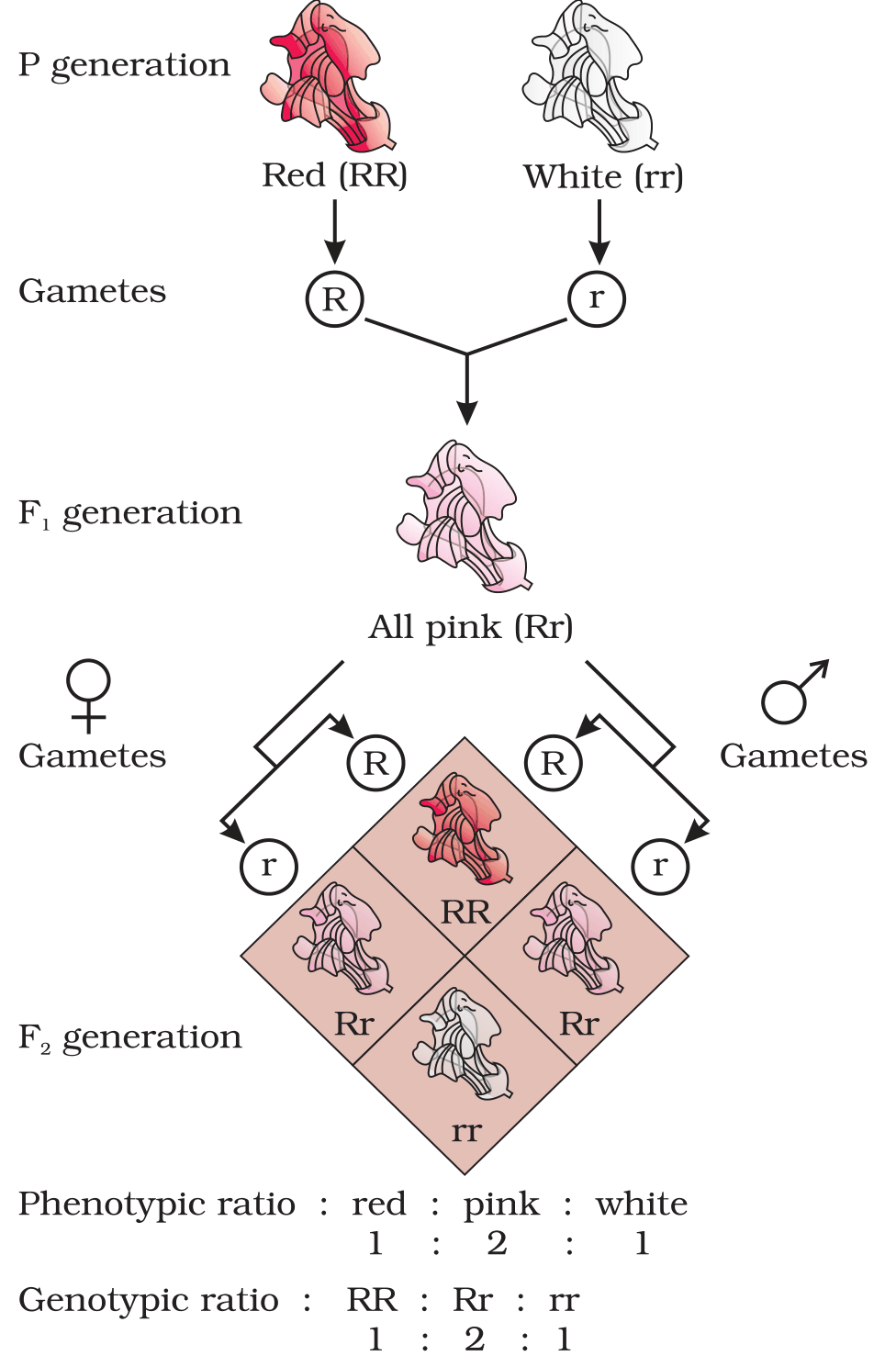
Figure 4.6 Results of monohybrid cross in the plant Snapdragon, where one allele is incompletely dominant over the other allele