
CUETMOCK
  • Pricing
  • Mentors
Log inStart freeStart free mocks→

First test, then trust

Try a free CUET mock test.

Join 5,00,000+ students who rehearsed exam day on the exact NTA screen before sitting CUET. On the web and on Android.

Start free mocks →Get the Android app
CUETMOCK

India's #1 CUET Mock Test Platform. Original NCERT-based questions on the exact NTA exam screen — trusted by 5,00,000+ students since CUET 2022.

Get it onGoogle PlayScan to download the CUETMOCK app

Mock tests

  • CUET mock test series
  • Browse all papers
  • Commerce mocks
  • Humanities (Arts) mocks
  • Science mocks
  • Languages & GAT mocks
  • Free practice questions
  • Pricing

Resources

  • CUET exam guide
  • CUET syllabus
  • Universities accepting CUET
  • Expert blogs
  • News & notifications
  • Webinars & counselling
  • CUET score calculator
  • How we estimate your rank
  • FAQs

Company

  • About us
  • Our leadership & team
  • Our toppers
  • Mentors
  • For schools
  • Contact us
  • Terms
  • Privacy
  • Refund policy

Talk to us

+91 7696 6630 56info@cuetmock.comWhatsApp us

Our other platforms

  • JEE Mock — For IIT-JEE aspirants
  • NEET Mock — For NEET aspirants

Newsletter

Exam updates, study material and offers — no spam.

© 2026 NYC Ventures Pvt. Ltd.

701-702, Royal Business Park, Zirakpur, Punjab - 140603

  • Terms of use
  • Privacy policy
  • Refund policy
  • Contact us

iCUETMOCK is an independent preparation platform, not affiliated with the National Testing Agency (NTA). Always check exam details on the official NTA website.

  • Home
  • Mock tests
  • CUET guide
  • Pricing
  • Log in
Home/Practice questions/History
HistoryAncient India: Kinship, Caste and Class

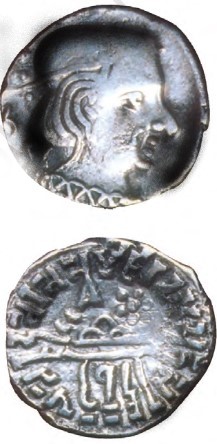
The silver coin of the fourth century CE depicts the ruler of which d…

The silver coin of the fourth century CE depicts the ruler of which dynasty?

Answer & explanation+

Correct answer: option 3

The correct answer is Option (3) → Shaka

The silver coin of about the fourth century CE shows a Shaka ruler; the Shakas came from Central Asia.

Advertisement

Practise more on Ancient India: Kinship, Caste and Class

Chapter-wise mocks on the real NTA exam screen, with solutions and your rank. Your first mocks are free.

Start free mocks →

Advertisement

Next questions

  1. Babur recorded his views on artists in his memoirs. Given below are two statements on what he wrote about the Persian master Bihzad: one is…Fine Arts · The Mughal School of Miniature Painting
  2. Arrange the following in chronological order:(A) Formation of the Bharatiya Jana Sangh by Shyama Prasad Mukherjee. (B) Spilt in the Communi…Political Science · Politics in India Since Independence: Era of one Party Dominance
  3. Three identical spherical shells, each of mass m and radius r are placed as shown in figure. Consider an axis XX' which is touching to two…Physics · System of Particle and Rotational Motion
  4. Match List – I with List – II. List - I(Equal amount of drawings made) List - II (Number of month for which interest calculated) (A) At the…Accountancy Part A · Accounting for Partnership
  5. When debentures are issued at par but redeemable at a premium, which of the account is credited at the time of issue regarding this?Accountancy · Issue and Redemption of Debentures
  6. Identify normative statements from the following :(A) India has a high population(B) India should keep a control on population growth rate(…Economics · Micro Economics: Introduction
  7. The base of a hemispherical bowl has a circumference of 132 cm. Find the capacity of the bowl.(Use π =22/7)General Aptitude Test · Quantitative Reasoning
  8. From the given options, select the OPPOSITE in meaning to the given word: "Perennial"English · Antonyms
  9. Which of the following statement/statements are true?Statement I: A rightward shift in the demand curve and a leftward shift in the supply…Economics · Micro Economics: Market Equilibrium
  10. A powerful military chieftain in Mughal India dispossessed weaker people to expand his zamindari. Which of the following would most likely…History · Medieval India: Peasants, Zamindars and the State