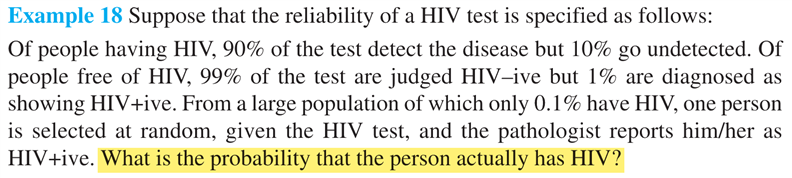
It is given that only 0.1% of a large population have COVID infection. In this population, the reliability of COVID RTPCR-test is specified as follows:
For persons having COVID, 90% of the test detects the disease but 10% goes undetected. For persons not having COVID, 99% of the test is judged COVID negative but 1% are diagnosed as COVID positive.
Based on the above information, answer the question:
The probability that the person is actually having COVID given that he is tested as COVID positive is:
Answer & explanation
Correct answer: option 1
The correct answer is Option (1) → \(\displaystyle\frac{10}{121}\)
Let E be the event that the person has COVID, and A the event that the test is positive. From the data:
\(P(E) = 0.001,\quad P(E') = 0.999\)
\(P(A/E) = 0.9,\quad P(A/E') = 0.01\)
By Bayes’ theorem:
\( \displaystyle P(E/A) = \frac{P(E)\,P(A/E)}{P(E)\,P(A/E) + P(E')\,P(A/E')} \)
\( \displaystyle = \frac{0.001\times 0.9}{0.001\times 0.9 + 0.999\times 0.01} \)
\( \displaystyle = \frac{0.0009}{0.0009 + 0.00999} = \frac{0.0009}{0.01089} \)
\( \displaystyle = \frac{900}{10890} = \frac{90}{1089} = \frac{10}{121} \)
NCERT (2026-27 edition):
Bayes Theorem