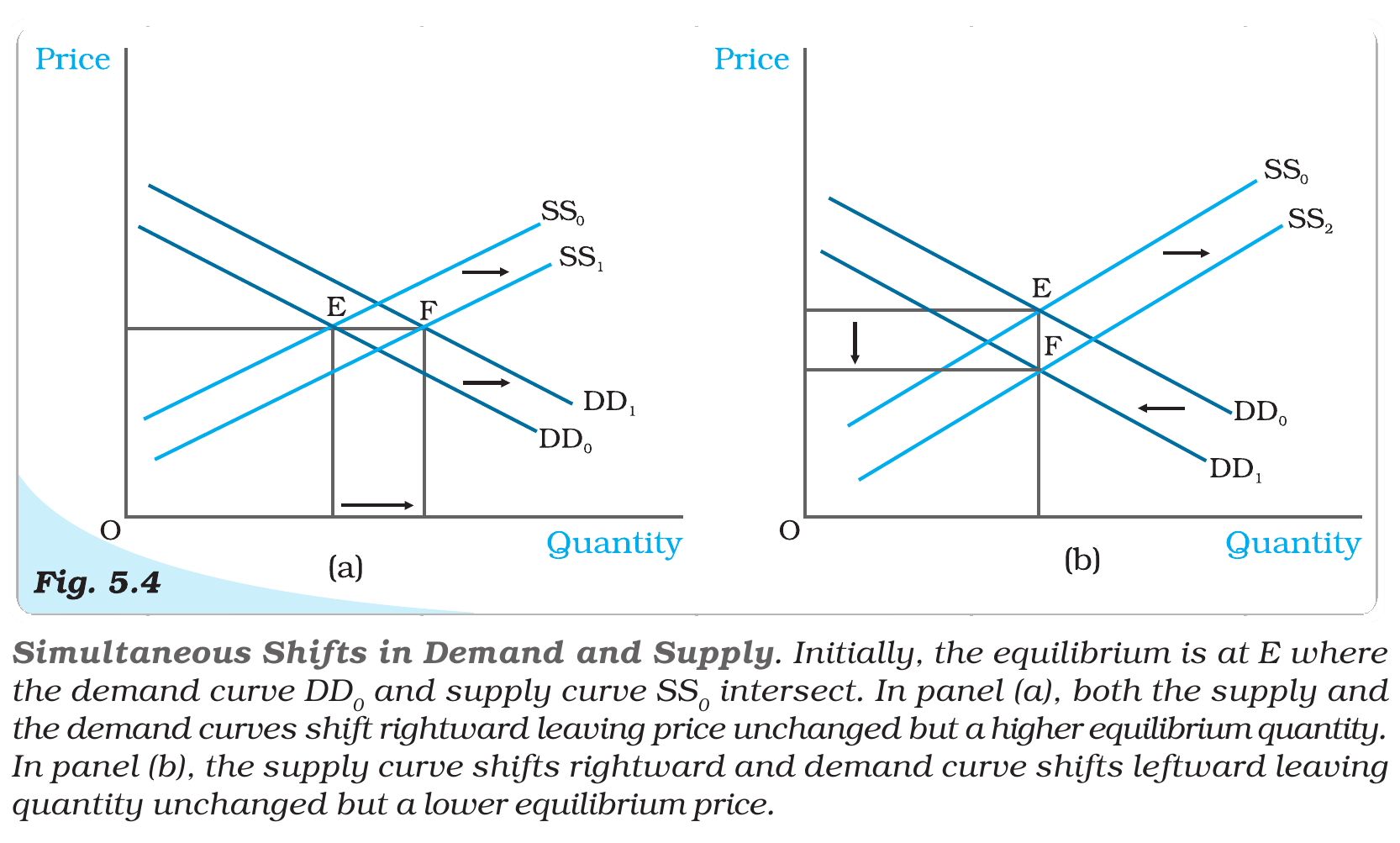
When both the demand and supply curves shift to indicate an increase in demand and supply in the same proportion. Then:
Answer & explanation
Correct answer: option 4
The correct answer is Option (4) → Equilibrium price remains unchanged but equilibrium quantity increases.
When demand and supply rise in the same proportion, the extra demand at the old price equals the extra supply. So the price stays the same, and the quantity rises.
If demand alone rises, there is excess demand at the old price, and the price goes up. If supply alone rises, there is excess supply, and the price goes down. Both raise the quantity.
Option (1) Only equilibrium price remains unchanged. — Incomplete. The price is unchanged, but the option does not say that the quantity rises. Option (4) gives the full result.
Option (2) Only equilibrium quantity remains unchanged. — Incorrect. Quantity stays the same when supply rises and demand falls by the same amount. Here both rise, so quantity rises.
Option (3) Equilibrium price remains unchanged but equilibrium quantity decreases. — Incorrect. This happens when both demand and supply fall equally. Here both rise.
Option (4) Equilibrium price remains unchanged but equilibrium quantity increases. — Correct. No excess demand or excess supply is left to move the price. So the pulls of demand and supply cancel out. Both shifts add to the quantity.
NCERT (2026-27): “Simultaneous Shifts of Demand and Supply …In the Figure 5.4(a), it can be seen that due to rightward shifts in both demand and supply curves, the equilibrium quantity increases whereas the equilibrium price remains unchanged, and in Figure 5.4(b), equilibrium quantity remains the same whereas price decreases due to a leftward shift in demand curve and a rightward shift in supply curve.”
|