
CUETMOCK
  • Pricing
  • Mentors
Log inStart freeStart free mocks→

First test, then trust

Try a free CUET mock test.

Join 5,00,000+ students who rehearsed exam day on the exact NTA screen before sitting CUET. On the web and on Android.

Start free mocks →Get the Android app
CUETMOCK

India's #1 CUET Mock Test Platform. Original NCERT-based questions on the exact NTA exam screen — trusted by 5,00,000+ students since CUET 2022.

Get it onGoogle PlayScan to download the CUETMOCK app

Mock tests

  • CUET mock test series
  • Browse all papers
  • Commerce mocks
  • Humanities (Arts) mocks
  • Science mocks
  • Languages & GAT mocks
  • Free practice questions
  • Pricing

Resources

  • CUET exam guide
  • CUET syllabus
  • Universities accepting CUET
  • Expert blogs
  • News & notifications
  • Webinars & counselling
  • CUET score calculator
  • How we estimate your rank
  • FAQs

Company

  • About us
  • Our leadership & team
  • Our toppers
  • Mentors
  • For schools
  • Contact us
  • Terms
  • Privacy
  • Refund policy

Talk to us

+91 7696 6630 56info@cuetmock.comWhatsApp us

Our other platforms

  • JEE Mock — For IIT-JEE aspirants
  • NEET Mock — For NEET aspirants

Newsletter

Exam updates, study material and offers — no spam.

© 2026 NYC Ventures Pvt. Ltd.

701-702, Royal Business Park, Zirakpur, Punjab - 140603

  • Terms of use
  • Privacy policy
  • Refund policy
  • Contact us

iCUETMOCK is an independent preparation platform, not affiliated with the National Testing Agency (NTA). Always check exam details on the official NTA website.

  • Home
  • Mock tests
  • CUET guide
  • Pricing
  • Log in
Home/Practice questions/Biology
BiologyEcosystem

Arrange the amount of energy in a sequence from the highest trophic l…

Arrange the amount of energy in a sequence from the highest trophic level to the lowest trophic level (Pyramid of Energy):

(A) 10,000 J

(B) 1000 J

(C) 10 J

(D) 100 J

Choose the correct answer from the options given below:

Answer & explanation+

Correct answer: option 3

The correct answer is Option (3) → (C), (D), (B), (A)

(C) 10 J — first: the highest trophic level, the tertiary consumers or top carnivores. By the 10 per cent law, only about 10 per cent of the energy at one level passes on to the next, so the top of the pyramid holds the least energy: 10 per cent of 100 J = 10 J. The sequence asked for therefore starts at the smallest value, not at 10,000 J.

(D) 100 J — second: the secondary consumers (small carnivores). They get 10 per cent of the 1000 J held by the herbivores, that is 100 J.

(B) 1000 J — third: the primary consumers (herbivores). They get 10 per cent of the 10,000 J held by the producers, that is 1000 J.

(A) 10,000 J — last: the producers, the lowest trophic level at the base of the pyramid. They hold the most energy because every other level depends on what they fix from sunlight. Option (1) gives this same chain read from the producers upwards, the reverse of what the question asks.

NCERT Extract:
Ecological Pyramids –
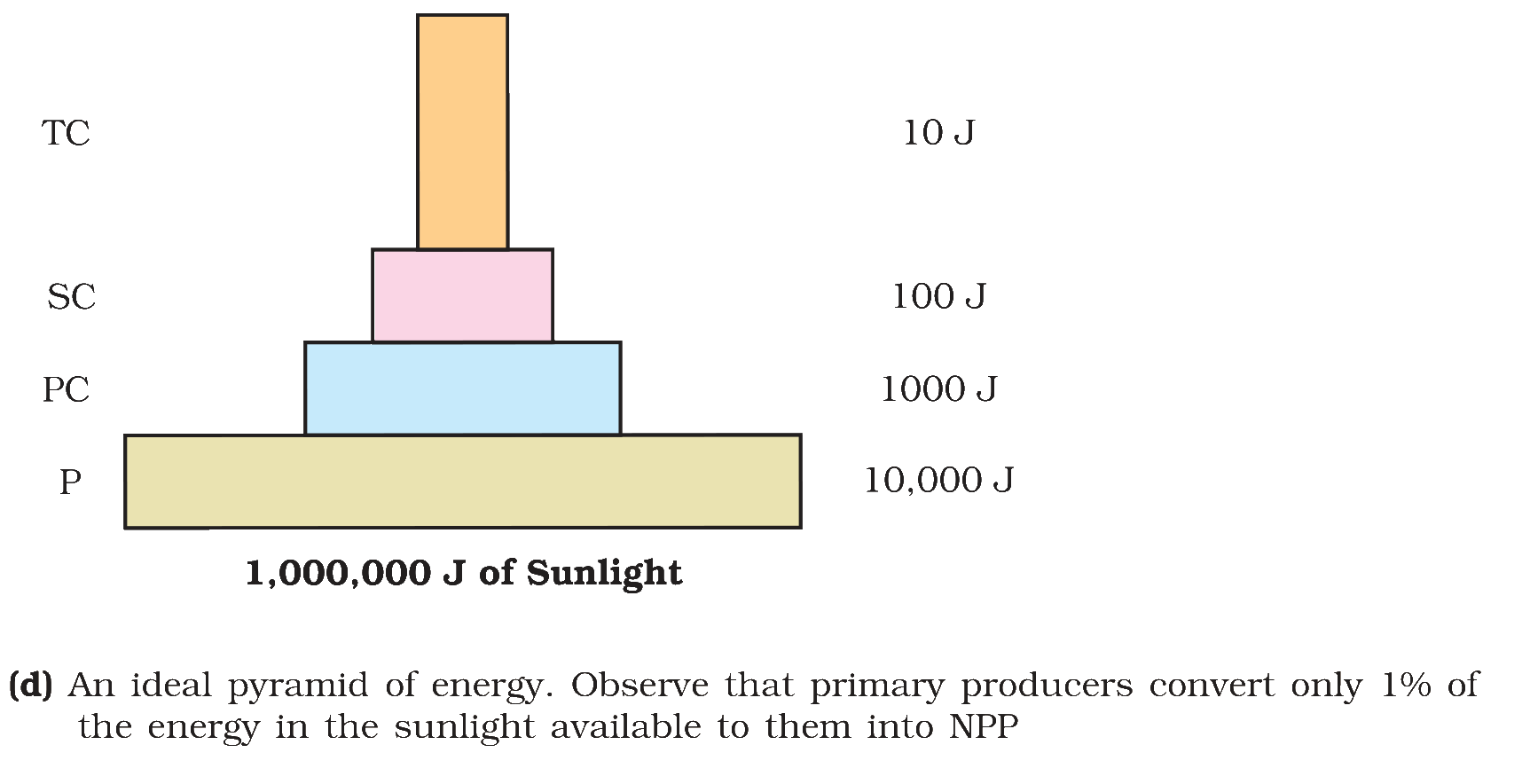
Textbook figure

Advertisement

Practise more on Ecosystem

Chapter-wise mocks on the real NTA exam screen, with solutions and your rank. Your first mocks are free.

Start free mocks →

Advertisement

Next questions

  1. Which of the following reagents can not be used to oxidise primary alcohols to aldehydes?Chemistry · Organic: Alcohols, Phenols and Ethers
  2. 20 teachers of a school either teach Mathematics or Physics. 12 of them teach Mathematics while 4 teach both the subjects. The number of te…Mathematics · Sets
  3. The question below is followed by two statements numbered I and II. Decide whether the data given in the statements are sufficient to answe…General Aptitude Test · Verbal Reasoning
  4. Which type of artwork is it?Fine Arts · The Modern Indian Art
  5. A window is in the form of a rectangle surmounted by a semicircle, the diameter of the semicircle being the top side of the rectangle. The…Applied Maths. Section B2 · Calculus
  6. Alamgir was the title of which Mughal emperor?General Aptitude Test · General Knowledge
  7. Abnormal behaviour is described as behaviour that is:A. DeviantB. DistressingC. DysfunctionalD. DangerousPsychology · Psychological Disorders
  8. 'India's Struggle for Independence' is one of the notable books written bu ______.General Aptitude Test · General Knowledge
  9. Select the word which means the same as the group of words given. A large natural or artificial lake used as a source of water supplyEnglish · One Word
  10. Why did peasants like him feel closer to Gandhiji than to many other leaders of the time?History · Modern India: Mahatma Gandhi and the Nationalist movement