"Planning is deciding in advance what to do and how to do." Choose the correct sequence of steps to be involved in the process of planning.
(A) Evaluating Alternatives Courses
(B) Identifying Alternatives Courses of Action
(C) Developing Premises
(D) Follow up Action
(E) Selecting an alternative
Choose the correct answer from the options given below:
Answer & explanation
Correct answer: option 3
The correct answer is Option (3) → (C), (B), (A), (E), (D)
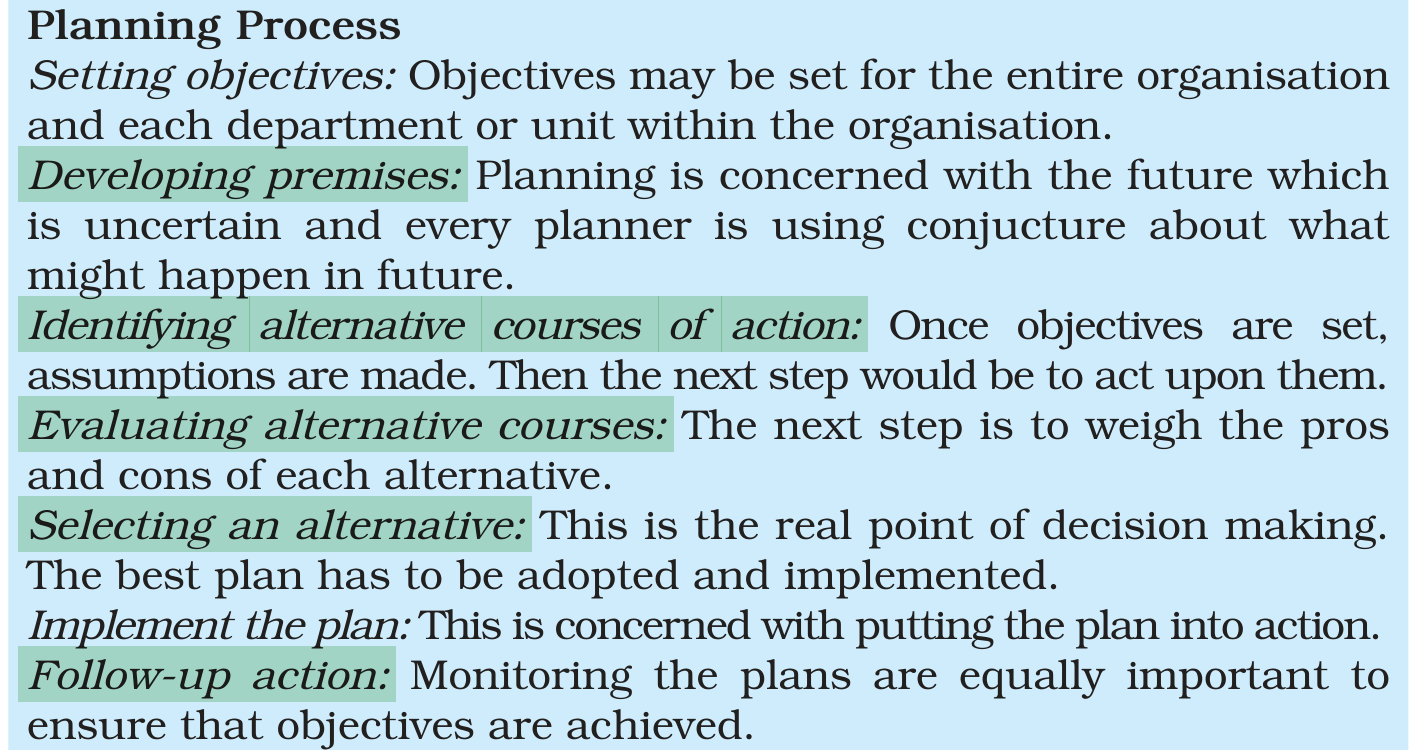
(C) Developing Premises — first of the five. Planning is about the future, which is uncertain. So the planner first makes assumptions (premises) about the future, for example through forecasts of demand, prices or tax rates. (In the full planning process, setting objectives comes even before this, but it is not in the list.)
(B) Identifying Alternatives Courses of Action — second. With the objectives and premises clear, the planner lists the different ways in which the goal can be reached.
(A) Evaluating Alternatives Courses — third. Each way is weighed for its good and bad points, in the light of the objective. A way can be judged only after it has been found.
(E) Selecting an alternative — fourth. This is the real point of decision making. The best plan is chosen after the evaluation.
(D) Follow up Action — last. After the plan is put into action, it is watched to see that the work goes as per schedule and the objectives are achieved.
NCERT (2026-27 Edition):
|