
CUETMOCK
  • Pricing
  • Mentors
Log inStart freeStart free mocks→

First test, then trust

Try a free CUET mock test.

Join 5,00,000+ students who rehearsed exam day on the exact NTA screen before sitting CUET. On the web and on Android.

Start free mocks →Get the Android app
CUETMOCK

India's #1 CUET Mock Test Platform. Original NCERT-based questions on the exact NTA exam screen — trusted by 5,00,000+ students since CUET 2022.

Get it onGoogle PlayScan to download the CUETMOCK app

Mock tests

  • CUET mock test series
  • Browse all papers
  • Commerce mocks
  • Humanities (Arts) mocks
  • Science mocks
  • Languages & GAT mocks
  • Free practice questions
  • Pricing

Resources

  • CUET exam guide
  • CUET syllabus
  • Universities accepting CUET
  • Expert blogs
  • News & notifications
  • Webinars & counselling
  • CUET score calculator
  • How we estimate your rank
  • FAQs

Company

  • About us
  • Our leadership & team
  • Our toppers
  • Mentors
  • For schools
  • Contact us
  • Terms
  • Privacy
  • Refund policy

Talk to us

+91 7696 6630 56info@cuetmock.comWhatsApp us

Our other platforms

  • JEE Mock — For IIT-JEE aspirants
  • NEET Mock — For NEET aspirants

Newsletter

Exam updates, study material and offers — no spam.

© 2026 NYC Ventures Pvt. Ltd.

701-702, Royal Business Park, Zirakpur, Punjab - 140603

  • Terms of use
  • Privacy policy
  • Refund policy
  • Contact us

iCUETMOCK is an independent preparation platform, not affiliated with the National Testing Agency (NTA). Always check exam details on the official NTA website.

  • Home
  • Mock tests
  • CUET guide
  • Pricing
  • Log in
Home/Practice questions/Chemistry
ChemistryOrganic: Polymers

Nylon 6, 6 is obtained by condensation polymerisation of

Nylon 6, 6 is obtained by condensation polymerisation of

Answer & explanation+

Correct answer: option 2

The correct answer is 2. adipic acid and hexamethylenediamine.

Nylon 6,6 is a condensation polymer that is formed by the reaction of adipic acid and hexamethylenediamine. The two monomers react to form a polyamide, which is a type of polymer that contains both amide and amine groups. The condensation reaction produces water as a byproduct.

Ethylene glycol and terephthalic acid are the monomers used to make nylon 6, which is a different type of nylon. Adipic acid and phenol are not used to make nylon.

Here is the reaction for the condensation polymerization of adipic acid and hexamethylenediamine to form nylon 6,6:
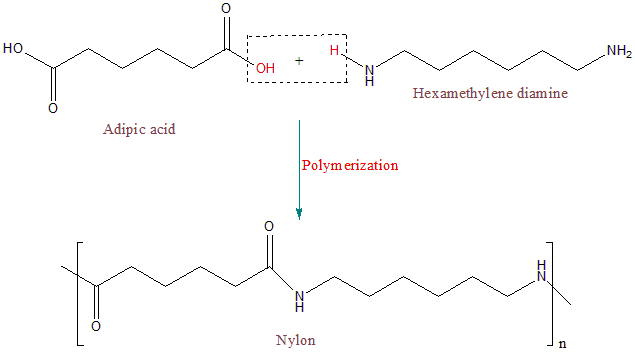
The product of the reaction is a long, chain-like molecule with amide and amine groups alternating along the chain. This molecule is called nylon 6,6.

Advertisement

Practise more on Organic: Polymers

Chapter-wise mocks on the real NTA exam screen, with solutions and your rank. Your first mocks are free.

Start free mocks →

Advertisement

Next questions

  1. In December 2023, India agreed to provide line of credit of USD 250 million to which of the following country for modernizing its agricultu…General Aptitude Test · Current Affairs
  2. Calculate Liquid Assets and Quick Ratio of the Company.Accountancy Part B · Accounting Ratios
  3. For the matrix A = […] to be invertible, the value of λ isMaths. Section B1 · Determinants
  4. What achievements have been made through decades of archaeological work on the Harappan civilization?History · Ancient India: Bricks, Beads and Bones
  5. If x = a(t + sin t), y = a(1 – cos t), then dy/dx is :Maths. Section A · Continuity and Differentiability
  6. Which part of the Constitution deals with amendments of the Constitution?General Aptitude Test · General Knowledge
  7. Which of the following pairs is correctly matched?History · Ancient India: Kings, Farmers and Towns
  8. The interval of increase of the function f(x)=x-e^x+tan((2π)/7) isMaths. Section A · Applications of Derivatives
  9. Who was the famous leader of the Bharatiya Kisan Union (BKU)?Political Science · Politics in India Since Independence: Rise of Popular Movements
  10. Match List-I with List-II.List-IList-II(A) ed = ∞(I) Shift in the curve(B) ed = 0(II) Movement along the curve(C) (III) Perfectly elastic(D…Economics · Micro Economics: Theory of Consumer behaviour