Choose the correct statements from the following in respect of exchange rate system.
(A) Floating Exchange Rate exchange rate is determined by the market forces of demand and supply.
(B) In a fixed exchange rate system, making domestic currency cheaper is called Devaluation.
(C) Increase in exchange rate implies that the price of foreign currency has increased and is called depreciation.
(D) Exchange rates between any two currencies adjust to reflect differences in the price levels in the two countries.
Choose the correct answer from the options given below:
Answer & explanation
Correct answer: option 4
The correct answer is Option (4) → (A), (B), (C) and (D)
The exchange rate is the price of one unit of foreign currency in terms of domestic currency.
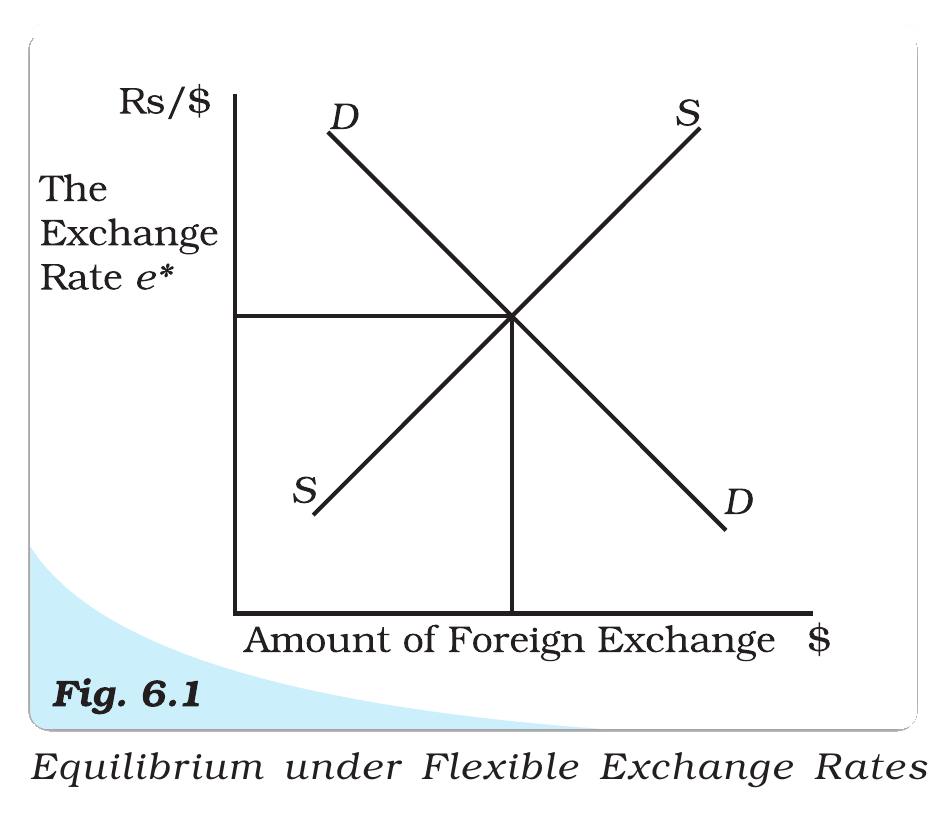
(A) Floating Exchange Rate exchange rate is determined by the market forces of demand and supply. — Correct. A floating rate is the same as a flexible rate. The rate is set where the demand curve for foreign exchange intersects the supply curve.
(B) In a fixed exchange rate system, making domestic currency cheaper is called Devaluation. — Correct. Government action raises the exchange rate, so the domestic currency becomes cheaper.
(C) Increase in exchange rate implies that the price of foreign currency has increased and is called depreciation. — Correct. More rupees are needed for one dollar. The rupee has lost value, and this is depreciation of the domestic currency.
(D) Exchange rates between any two currencies adjust to reflect differences in the price levels in the two countries. — Correct. This is the purchasing power parity theory. Over the long run, rates adjust so that the same product costs the same in both countries, apart from transport costs.
NCERT (2026-27): “Flexible Exchange Rate This exchange rate is determined by the market forces of demand and supply. It is also known as Floating Exchange Rate. As depicted in Fig. 6.1, the exchange rate is determined where the demand curve intersects with the supply curve, i.e., at point e on the Y – axis. … At the new equilibrium, the exchange rate becomes e1 = 70, which means that we need to pay more rupees for a dollar now (i.e., Rs 70). It indicates that the value of rupees in terms of dollars has fallen and value of dollar in terms of rupees has risen. Increase in exchange rate implies that the price of foreign currency (dollar) in terms of domestic currency (rupees) has increased. This is called Depreciation of domestic currency (rupees) in terms of foreign currency (dollars).… Exchange Rates in the Long Run … Over the long run, therefore, exchange rates between any two national currencies adjust to reflect differences in the price levels in the two countries.… Fixed Exchange Rates … In a fixed exchange rate system, when some government action increases the exchange rate (thereby, making domestic currency cheaper) is called Devaluation. On the other hand, a Revaluation is said to occur, when the Government decreases the exchange rate (thereby, making domestic currency costlier) in a fixed exchange rate system.”
|