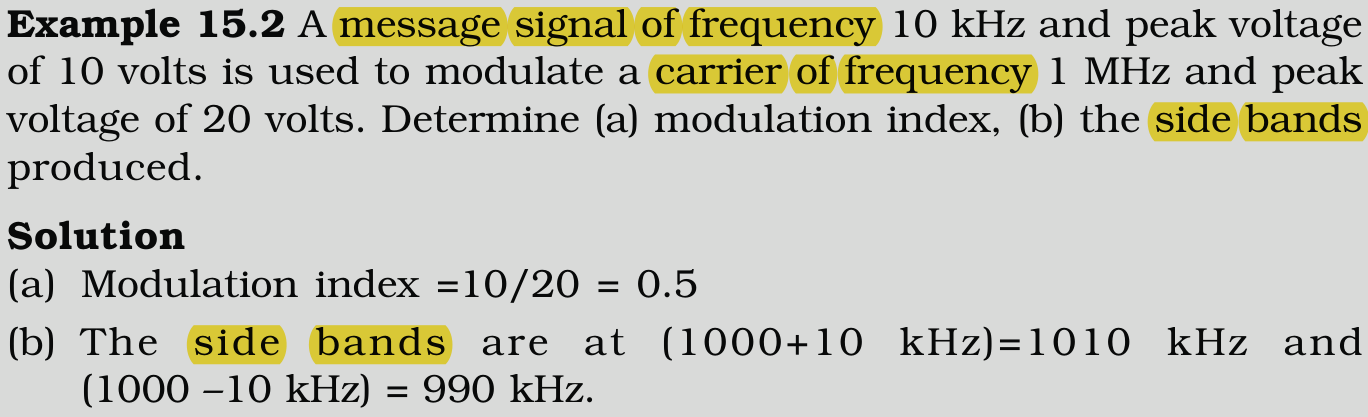
A signal of 5 kHz frequency is amplitude modulated on a carrier wave of frequency 3 MHz. The frequency of the resultant signal are:
Answer & explanation
Correct answer: option 3
The correct answer is Option (3) → 3000 kHz, 3005 kHz and 2995 kHz
An amplitude modulated wave contains the carrier frequency \( f_c \) together with two side bands, the upper side frequency \( f_c + f_m \) and the lower side frequency \( f_c - f_m \), where \( f_m \) is the signal frequency.
\( f_c = 3\,\mathrm{MHz} = 3000\,\mathrm{kHz},\quad f_m = 5\,\mathrm{kHz} \)
\( f_c + f_m = 3005\,\mathrm{kHz} \)
\( f_c - f_m = 2995\,\mathrm{kHz} \)
The modulated wave therefore has the three frequencies 3000 kHz, 3005 kHz and 2995 kHz.
Note: This question is from the pre-rationalised NCERT book (2022-23). The topic was removed from the latest NCERT book (2026-27), and it also appears to be out of the CUET 2026 syllabus.
NCERT (Pre-rationalised edition, 2022-23):
Amplitude Modulation – …