
CUETMOCK
  • Pricing
  • Mentors
Log inStart freeStart free mocks→

First test, then trust

Try a free CUET mock test.

Join 5,00,000+ students who rehearsed exam day on the exact NTA screen before sitting CUET. On the web and on Android.

Start free mocks →Get the Android app
CUETMOCK

India's #1 CUET Mock Test Platform. Original NCERT-based questions on the exact NTA exam screen — trusted by 5,00,000+ students since CUET 2022.

Get it onGoogle PlayScan to download the CUETMOCK app

Mock tests

  • CUET mock test series
  • Browse all papers
  • Commerce mocks
  • Humanities (Arts) mocks
  • Science mocks
  • Languages & GAT mocks
  • Free practice questions
  • Pricing

Resources

  • CUET exam guide
  • CUET syllabus
  • Universities accepting CUET
  • Expert blogs
  • News & notifications
  • Webinars & counselling
  • CUET score calculator
  • How we estimate your rank
  • FAQs

Company

  • About us
  • Our leadership & team
  • Our toppers
  • Mentors
  • For schools
  • Contact us
  • Terms
  • Privacy
  • Refund policy

Talk to us

+91 7696 6630 56info@cuetmock.comWhatsApp us

Our other platforms

  • JEE Mock — For IIT-JEE aspirants
  • NEET Mock — For NEET aspirants

Newsletter

Exam updates, study material and offers — no spam.

© 2026 NYC Ventures Pvt. Ltd.

701-702, Royal Business Park, Zirakpur, Punjab - 140603

  • Terms of use
  • Privacy policy
  • Refund policy
  • Contact us

iCUETMOCK is an independent preparation platform, not affiliated with the National Testing Agency (NTA). Always check exam details on the official NTA website.

  • Home
  • Mock tests
  • CUET guide
  • Pricing
  • Log in
Home/Practice questions/General Aptitude Test
General Aptitude TestVerbal ReasoningSyllogism

In the following question below are given some statements followed by…

In the following question below are given some statements followed by some conclusions based on those statements. taking the given statements to be true even if they seem to be at variance from commonly known facts. Read all the conclusions and then decide which of the given conclusion logically follows the given statements.

Statements:

All pens are cars.

Some cars are bulbs. 

Conclusions:

I. Some cars are not bulbs

II. Some pens being bulbs is a possibility

Answer & explanation+

Correct answer: option 4

A possible Venn diagram corresponding to the statements is - 
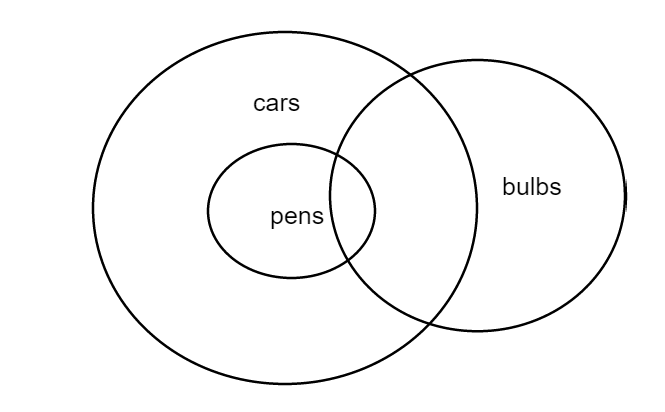
 

Cars and bulbs overlap. Thus Conclusion I is definitely wrong.

Some pens being bulbs is a possibility  as seen in the diagram. Thus, Conclusion II can be true.

Advertisement

Practise more on Verbal Reasoning

Chapter-wise mocks on the real NTA exam screen, with solutions and your rank. Your first mocks are free.

Start free mocks →

Advertisement

Next questions

  1. Kala-azar disease is caused by ______.General Aptitude Test · General Knowledge
  2. Match List-I with List-II List-I (Principle of Management) List-II (Explanation) (A) Harmony, Not Discord (I) Scientific selection of the w…Business Studies · Principles of Management
  3. How many persons were needed to work this bucket lift, by the emperor's account?History · Medieval India: Peasants, Zamindars and the State
  4. Select the odd pair of numbers from the given alternatives.General Aptitude Test · Verbal Reasoning
  5. It has been suggested by psychologists that giftedness from the teachers' point of view depends on a combination of high _____, high creati…Psychology · Variations in Psychological Attributes
  6. If the mode of the following data is 25, then find the value of p? 25, 7, 11, (3p-2), 25, 7, 18, 18, 25, 16General Aptitude Test · Numerical Ability
  7. Rearrange the parts of the sentence in correct order. P. actually move so slowly that algae grows on their fur and Q. the forest from preda…English · Arrange in Meaningful Sequence
  8. Give IUPAC name of the following compound: CH_3-CH_2-CH_2-CH(Br)-CH(CH_3)-CH_2-CHOChemistry · Organic: Aldehydes, Ketones and Carboxylic Acids
  9. Who proposed the two-step concept of attitude change?Psychology · Attitudes and Social Cognition
  10. The collection of all possible combinations of the goods and services that can be produced from a given amount of resources and a given sto…Economics · Micro Economics: Introduction