
The figure shows the resonance structures of aniline.
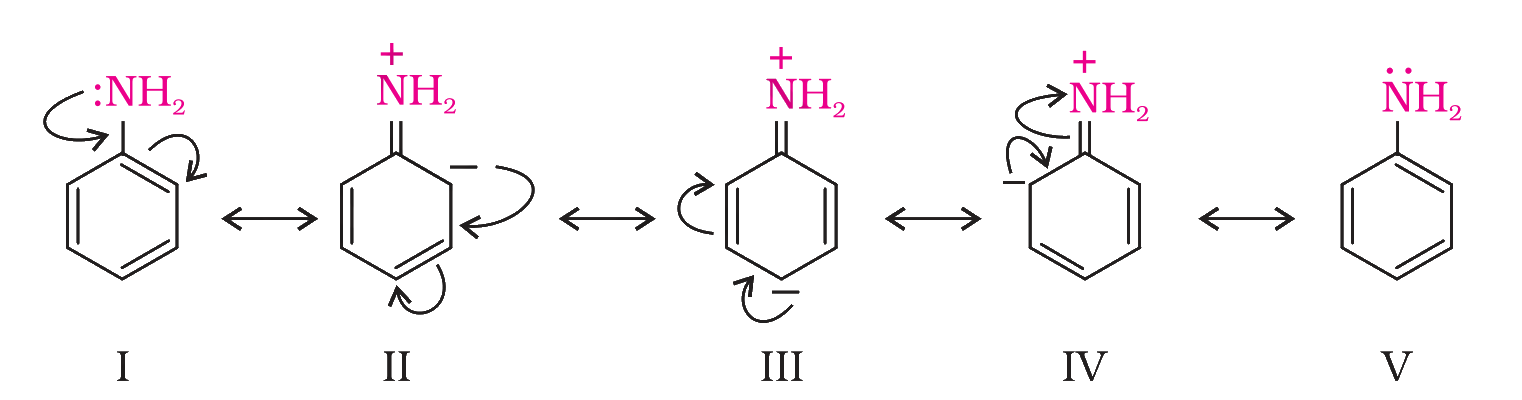
In structures II, III and IV, the negative charge is on ring carbons at which positions with respect to the –NH2 group, and what does this make the –NH2 group in electrophilic substitution?
Answer & explanation
Correct answer: option 1
The correct answer is Option (1) → Ortho and para positions; ortho and para directing
The unshared pair of nitrogen moves into the ring. In structures II and IV the negative charge is on a carbon next to the carbon carrying N (ortho), and in III it is on the carbon opposite to it (para). No structure puts the charge on a meta carbon.
The ortho and para carbons therefore become centres of high electron density, and an electrophile attacks them. So the –NH2 group is ortho and para directing and a powerful activating group.
Why the other options are incorrect
Option (2) Ortho and para positions; meta directing — Incorrect. The positions are right, but a high electron density at ortho and para draws the electrophile to those positions, so the group is ortho and para directing, not meta directing.
Option (3) Meta positions; meta directing — Incorrect. None of the structures carries the negative charge on a meta carbon; it is ortho in II and IV and para in III.
Option (4) Meta positions; ortho and para directing — Incorrect. The directing effect is right, but the charged carbons are ortho and para, not meta.
NCERT (2026-27 edition):
9.6 Chemical Reactions – “…in aniline or other arylamines, the -NH2 group is attached directly to the benzene ring. It results in the unshared electron pair on nitrogen atom to be in conjugation with the benzene ring and thus making it less available for protonation. If you write different resonating structures of aniline, you will find that aniline is a resonance hybrid of the following five structures.”
“…Ortho- and para-positions to the –NH2 group become centres of high electron density. Thus –NH2 group is ortho and para directing and a powerful activating group.”
Resonance structures of aniline