
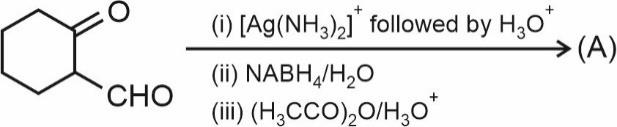
Identify the product (A) formed in the following sequence of reaction
Answer & explanation
Correct answer: option 3
The correct answer is Option (3) → 2-acetoxycyclohexane-1-carboxylic acid
The starting compound, 2-oxocyclohexane-1-carbaldehyde, has an aldehyde (–CHO) and a ring ketone. Each reagent acts on one group:
(i) [Ag(NH3)2]+ (Tollens’ reagent), then H3O+: a mild oxidising agent that oxidises only the aldehyde to –COOH; the ketone is not affected. Product: 2-oxocyclohexane-1-carboxylic acid.
\( \text{RCHO} + \ce{2[Ag(NH3)2]+ + 3OH- -> } \text{RCOO}^- + \ce{2Ag v + 2H2O + 4NH3} \)
(ii) NaBH4/H2O: reduces the ketone to a secondary alcohol (CH–OH); it does not reduce the carboxylic acid. Product: 2-hydroxycyclohexane-1-carboxylic acid.
\( \ce{>C=O} \xrightarrow[\ce{H2O}]{\ce{NaBH4}} \ce{>CH-OH} \)
(iii) (CH3CO)2O/H3O+: acetic anhydride acetylates the –OH group to –\( \ce{OCOCH3} \).
\( \ce{R-OH + (CH3CO)2O -> R-OCOCH3 + CH3COOH} \)
The product (A) is 2-acetoxycyclohexane-1-carboxylic acid, structure (3).
Why the other options are incorrect
Option (1) — Incorrect. This is the product of step (i) only; the ketone has not yet been reduced.
Option (2) — Incorrect. This is the product after step (ii); acetic anhydride in step (iii) acetylates its –OH group.
Option (4) — Incorrect. It shows –\( \ce{OCH3} \), a methyl ether; acetic anhydride introduces an acetyl group (–\( \ce{OCOCH3} \)), not a methyl group.