
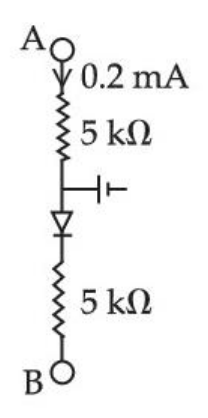
In the circuit shown here, if the voltage drop across forward biased diode is 0.3 V, the voltage difference between A and B would be:
Answer & explanation
Correct answer: option 1
The correct answer is Option (1) → 2.3 V
The potential difference between A and B is the sum of the potential drops along the path from A to B. The same current of 0.2 mA flows through both resistors and the forward biased diode, because the side branch with the cell is open and carries no current.
\( I = 0.2\,\mathrm{mA} = 2\times10^{-4}\,\mathrm{A} \)
\( R = 5\,\mathrm{k\Omega} = 5\times10^{3}\,\Omega \)
Drop across each resistor (Ohm's law):
\( \displaystyle V_R = I R = 2\times10^{-4} \times 5\times10^{3} = 1\,\mathrm{V} \)
Adding the two resistor drops and the diode drop:
\( \displaystyle V_{AB} = 1 + 0.3 + 1 = 2.3\,\mathrm{V} \)
Note: A similar question was also asked in CUET (UG) 2022 on 30-08-2022 (Slot 2).