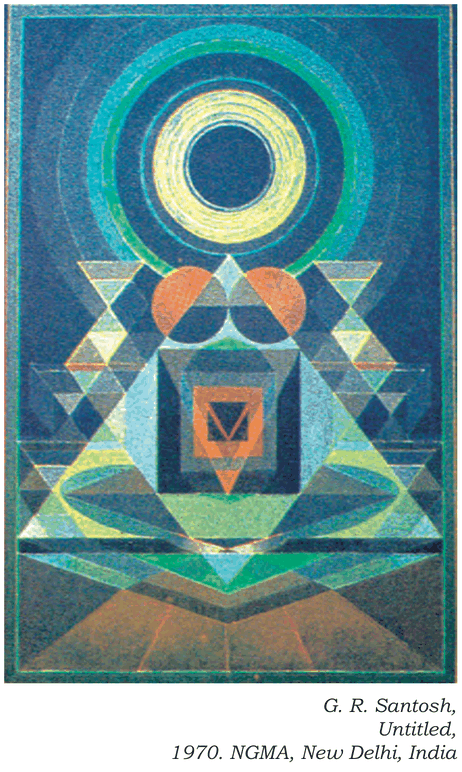
Several modern Indian artists found new directions for Indian art. Match the artists in List-I with their contributions in List-II.
| List-I (Artist) | List-II (Contribution) |
| A. G. R. Santosh | I. Mural as public art |
| B. Benode Behari Mukherjee | II. Let students explore new avenues |
| C. K. C. S. Paniker | III. Diagrams, scripts and pictograms |
| D. Nandalal Bose | IV. Cosmic union of male-female energy |
Choose the correct answer from the options given below:
Answer & explanation
Correct answer: option 1
The correct answer is Option (1) → A-IV, B-I, C-III, D-II
| List-I | List-II | Reason |
|---|---|---|
| (A) G. R. Santosh | (IV) Created a visual sense of the cosmic union of male and female energy | His work recalls purusha and prakriti of the Tantric philosophy, as in his Untitled of 1970. |
| (B) Benode Behari Mukherjee | (I) Saw the potential of a mural to become public art | He painted the mural The Lives of Medieval Saints at Hindi Bhavana, Shantiniketan, and was among the earliest to see this potential. |
| (C) K. C. S. Paniker | (III) Evolved a style out of diagrams, scripts and pictograms seen in his region | From these local sources he made a style both modern and uniquely Indian. |
| (D) Nandalal Bose | (II) Allowed his students and other teachers to explore new avenues of expression | He joined Kala Bhavana in 1921–1922. His training in nationalist art did not stop him from giving others this freedom. |
NCERT (2026-27): “Abstraction – A New Trend …G. R. Santosh created a visual sense of cosmic union of male and female energy, reminding us of purusha and prakriti of the Tantric philosophy. K. C. S. Paniker, on the other hand, made use of diagrams, scripts and pictograms that he saw in his region and evolved out of them a style, which was both modern and uniquely Indian.”
“The Lives of Medieval Saints The Lives of Medieval Saints, a mural in Hindi Bhavana, Shantiniketan, was created by Benode Behari Mukherjee around the eve of India’s Independence from Colonial rule, during 1946–1947. …He was one of the earliest artists in modern India to realise the potential of a mural to become public art.” “Introduction to Modernism in India …Nandalal Bose in 1921–1922 joined the Kala Bhavana. His training under Abanindranath Tagore made him familiar with nationalism in art but it did not hinder him from allowing his students and other teachers to explore new avenues of artistic expression.” |