
Which of the following will give zero current through the resistor of \( 2\,\Omega \).
Answer & explanation
Correct answer: option 2
The correct answer is Option (2)
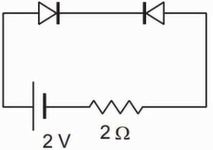
An ideal p-n junction diode conducts when it is forward biased and blocks the current when it is reverse biased. In every circuit the 2 V cell tries to send current out of its positive terminal (the longer plate) around the loop, and the \( 2\,\Omega \) resistor is in series with the diode part of the loop. So the current through the resistor is zero only if every path through the diode part contains a reverse-biased diode.
In Option (2) the two diodes are in series and point in opposite directions (back to back). Whichever way the current tries to flow, one of the two diodes is reverse biased, so no current flows through the \( 2\,\Omega \) resistor.
Why the other options are incorrect
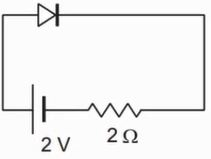
Option (1) — Incorrect. The single diode points along the direction in which the cell drives the current, so it is forward biased and current flows.
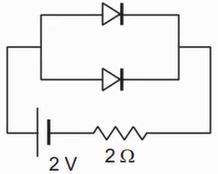
Option (3) — Incorrect. Both parallel diodes point along the direction in which the cell drives the current; both are forward biased and current flows.
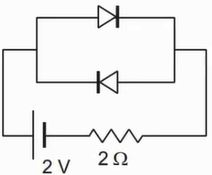
Option (4) — Incorrect. The two parallel diodes point in opposite directions, so one of them is always forward biased and current flows through it.
NCERT (2026-27):
Application of Junction Diode as a Rectifier – “From the V-I characteristic of a junction diode we see that it allows current to pass only when it is forward biased.”