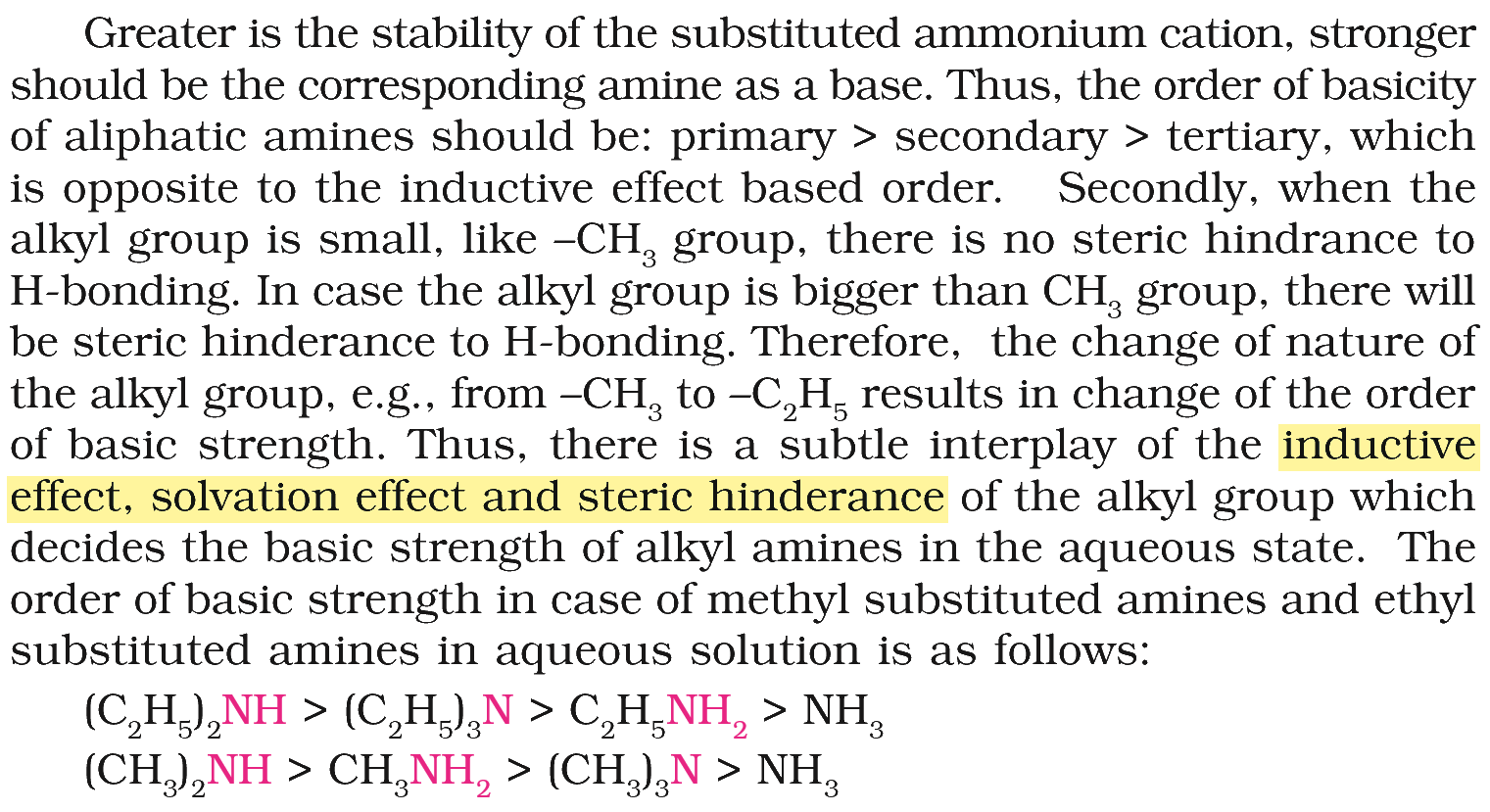
Which of the following factors are not responsible for deciding the order of basic strength of methyl- and ethyl-substituted amines in aqueous solution?
Answer & explanation
Correct answer: option 2
The correct answer is Option (2) → Electromeric Effect
An amine is basic because the lone pair on nitrogen can accept a proton. In water, the basic strength of methyl- and ethyl-substituted amines is decided by three factors acting together:
Inductive effect (+I): alkyl groups push electrons towards nitrogen and make the lone pair more available.
Solvation effect: the protonated amine is stabilised by hydrogen bonding with water; the more N–H hydrogens it has, the better it is stabilised.
Steric effect: bulky alkyl groups crowd the nitrogen and hinder both proton approach and solvation.
Option (1) Inductive Effect — A factor that decides the order. On this count alone, basicity rises with the number of alkyl groups: 3° > 2° > 1° > \( \ce{NH3} \).
Option (2) Electromeric Effect — Not a factor that decides the order. It is a temporary shift of a π electron pair of a multiple bond in the presence of an attacking reagent; alkylamines have no multiple bond.
Option (3) Solvation Effect — A factor that decides the order. On this count alone: 1° > 2° > 3°, since the primary ammonium ion has the most N–H hydrogens to hydrogen-bond with water.
Option (4) Steric Effect — A factor that decides the order. It is least for 1° and greatest for 3° amines, so it works against the +I effect.
NCERT (2026-27 edition):
Alkanamines versus Ammonia – …