
In the linear programming problem:
Minimize \( z=x+y \), subject to the constraints:
\( x+3y\le 60,\ x+y\ge 10,\ x\le y,\ x\ge 0,\ y\ge 0 \)
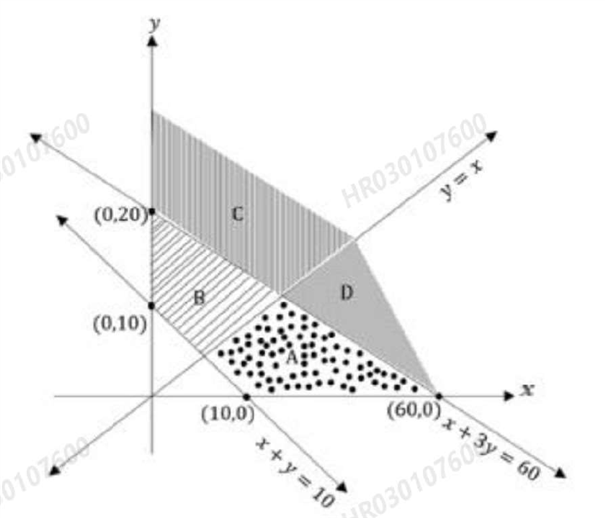
Which of the following region in graph given below represents the feasible region of the above LPP?
Answer & explanation
Correct answer: option 2
The correct answer is Option (2) → B
The side of each boundary line is decided by testing a point, the origin where possible.
\( x+3y\le 60 \): the origin satisfies it (0 ≤ 60), so the region lies on the origin side of \( x+3y=60 \), that is, below it.
\( x+y\ge 10 \): the origin does not satisfy it (0 ≥ 10 is false), so the region lies above the line \( x+y=10 \).
\( x\le y \): the line y = x passes through the origin, so test the point (0, 1); there 0 ≤ 1, so the region lies on the y-axis side of the line y = x, that is, above it.
\( x\ge 0,\ y\ge 0 \): the first quadrant.
The only region that is below \( x+3y=60 \), above \( x+y=10 \) and above y = x is B. Its corner points are
\( \displaystyle (0,10),\ (5,5),\ (15,15),\ (0,20) \)
Why the other options are incorrect
Option (1) A — Incorrect. Region A lies below the line y = x, so its points have x > y and break \( x\le y \).
Option (3) C — Incorrect. Region C lies above the line \( x+3y=60 \), so its points break \( x+3y\le 60 \).
Option (4) D — Incorrect. Region D lies above \( x+3y=60 \) and below y = x, so it breaks both \( x+3y\le 60 \) and \( x\le y \).