
Among the following reactions, which gives (give) tert-butylbenzene as the major product?
Choose the correct answer from the options given below:
Answer & explanation
Correct answer: option 2
The correct answer is Option (2) → A, C and D
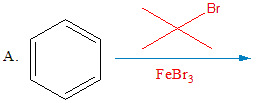
Friedel-Crafts alkylation goes through a carbocation, and a carbocation rearranges (by a 1,2-hydride shift) to a more stable one whenever it can. tert-Butylbenzene is formed whenever the electrophile is, or becomes, the tert-butyl cation. With tert-butyl bromide the Lewis acid gives this cation directly:
\( \displaystyle \ce{C6H6 + (CH3)3CBr} \xrightarrow{\ce{FeBr3}} \ce{C6H5C(CH3)3 + HBr} \)
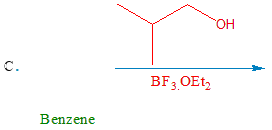
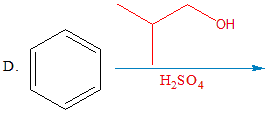
With 2-methylpropan-1-ol the acid (or \( \ce{BF3} \)) removes the OH group, and the primary cation rearranges to the tertiary one before it attacks the ring:
\( \displaystyle \ce{(CH3)2CHCH2OH + H+ -> (CH3)2CHCH2^+ + H2O} \)
\( \displaystyle \ce{(CH3)2CHCH2^+ -> (CH3)3C^+}\qquad(\text{1,2-hydride shift}) \)
\( \displaystyle \ce{C6H6 + (CH3)3C^+ -> C6H5C(CH3)3 + H+} \)
A. Benzene + \( \ce{(CH3)3CBr} \), \( \ce{FeBr3} \) — Correct. The Lewis acid takes \( \ce{Br^{-}} \) from tert-butyl bromide and gives \( \ce{(CH3)3C^{+}} \) directly.
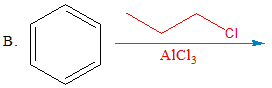
B. Benzene + \( \ce{CH3CH2CH2Cl} \), \( \ce{AlCl3} \) — Incorrect. A three-carbon halide can give at most a propyl or (after rearrangement) isopropyl group; the major product is isopropylbenzene (cumene), not a four-carbon tert-butyl group.
C. Benzene + \( \ce{(CH3)2CHCH2OH} \), \( \ce{BF3} \)·\( \ce{OEt2} \) — Correct. The Lewis acid helps the OH group leave; the primary isobutyl cation rearranges by a 1,2-hydride shift to \( \ce{(CH3)3C^{+}} \), which alkylates benzene.
D. Benzene + \( \ce{(CH3)2CHCH2OH} \), \( \ce{H2SO4} \) — Correct. The acid protonates the alcohol, water leaves, and the same rearrangement gives the tert-butyl cation.
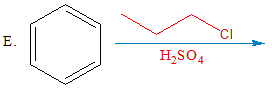
E. Benzene + \( \ce{CH3CH2CH2Cl} \), \( \ce{H2SO4} \) — Incorrect. Again only three carbons are available, so no tert-butyl group can form; besides, \( \ce{H2SO4} \) does not ionise an alkyl chloride the way a Lewis acid does.
Note: The question is from beyond the NCERT textbook.