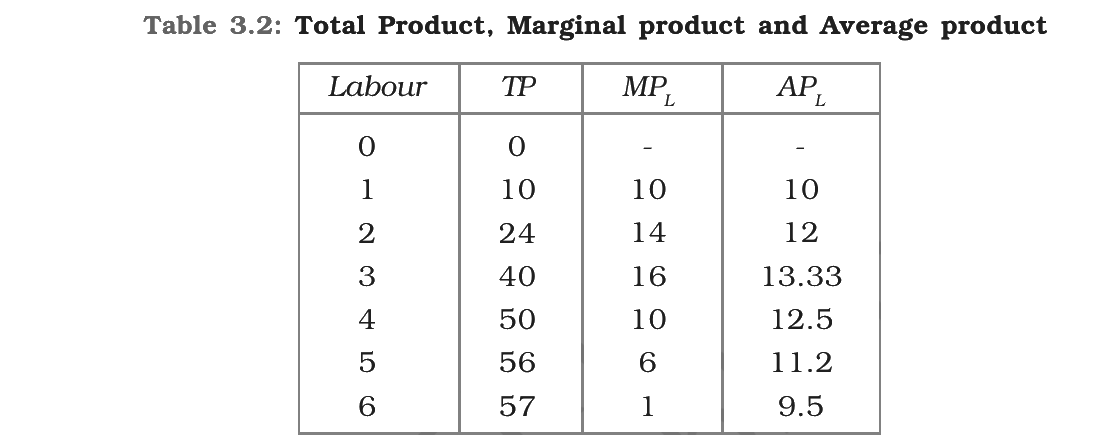
The table below gives the total product (TP) of labour, with capital fixed at 4 units:
| Labour (units) | 0 | 1 | 2 | 3 | 4 | 5 | 6 |
|---|---|---|---|---|---|---|---|
| TP (units) | 0 | 10 | 24 | 40 | 50 | 56 | 57 |
Up to which unit of labour does the marginal product of labour rise?
Answer & explanation
Correct answer: option 1
The correct answer is Option (1) → Up to the 3rd unit
Marginal product is the change in TP when one more unit of labour is added.
MP: 10, 14, 16, 10, 6, 1 for units 1 to 6.
It rises up to the 3rd unit (16) and falls from the 4th unit (10).
NCERT (2026-27): “3.4 The Law of Diminishing Marginal Product and the Law of Variable Proportions … The rate at which TP increases, as explained above, is shown by the MP. Notice that the MP first increases (upto 3 units of labour) and then begins to fall. This tendency of the MP to first increase and then fall is called the law of variable proportions or the law of diminishing marginal product.”
|