Identify the correct order of increasing atomic radius of the following elements of the first transition series: Ti, V, Sc
Answer & explanation
Correct answer: option 3
The correct answer is Option (3) → V < Ti < Sc
Along a transition series each new electron enters an inner d orbital as the nuclear charge rises by one. A d electron shields poorly, so the attraction of the nucleus for the outer electrons increases and the atomic radius decreases with increasing atomic number.
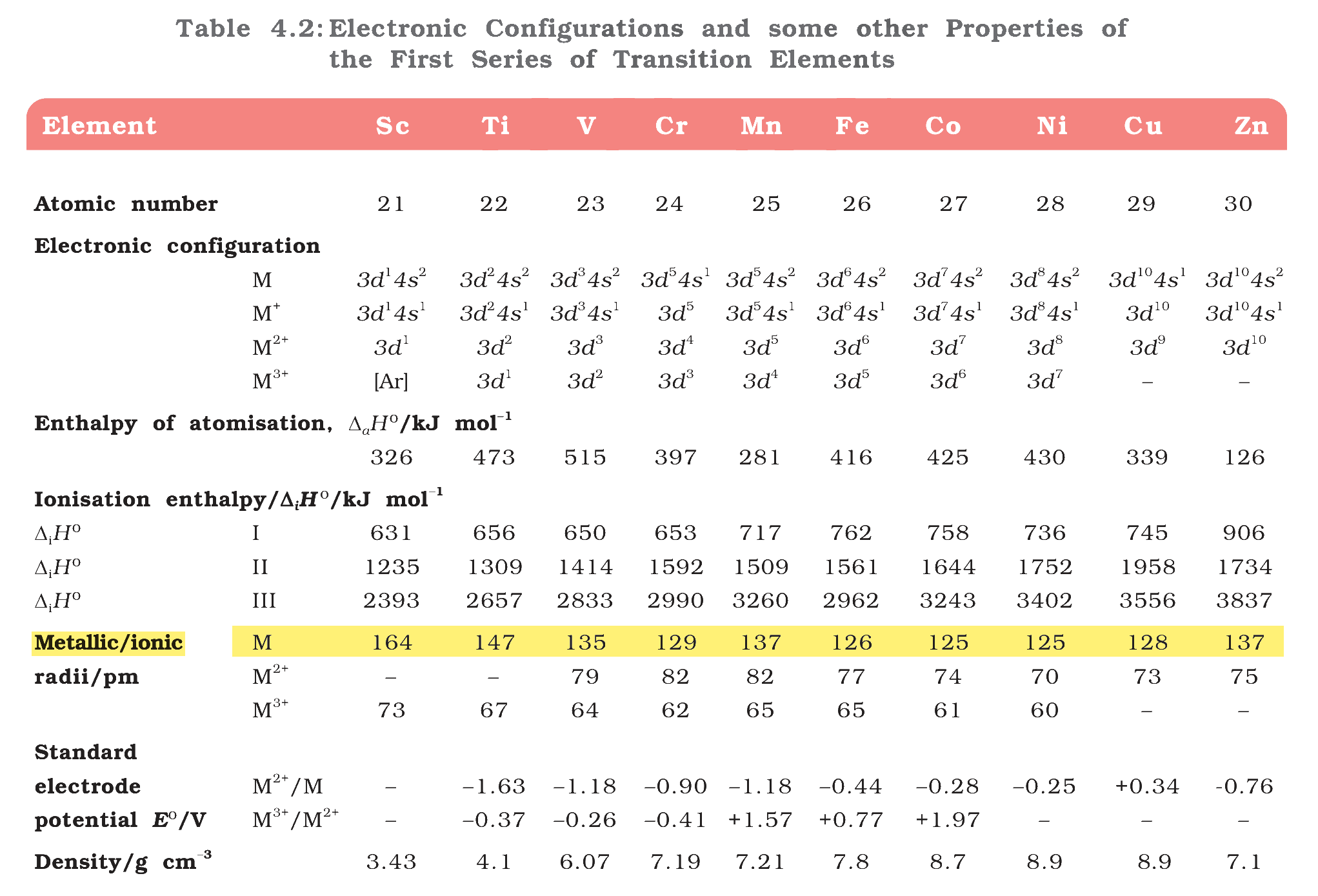
V (Z = 23, 3d34s2) — first (smallest). Highest nuclear charge of the three: metallic radius 135 pm.
Ti (Z = 22, 3d24s2) — second. Metallic radius 147 pm.
Sc (Z = 21, 3d14s2) — last (largest). Lowest nuclear charge of the three: metallic radius 164 pm.
NCERT (2026-27 edition):
4.3.2 Variation in Atomic and Ionic Sizes of Transition Metals – “In general, ions of the same charge in a given series show progressive decrease in radius with increasing atomic number. This is because the new electron enters a d orbital each time the nuclear charge increases by unity. It may be recalled that the shielding effect of a d electron is not that effective, hence the net electrostatic attraction between the nuclear charge and the outermost electron increases and the ionic radius decreases. The same trend is observed in the atomic radii of a given series.”
Table 4.2: Electronic Configurations and some other Properties of the First Series of Transition Elements