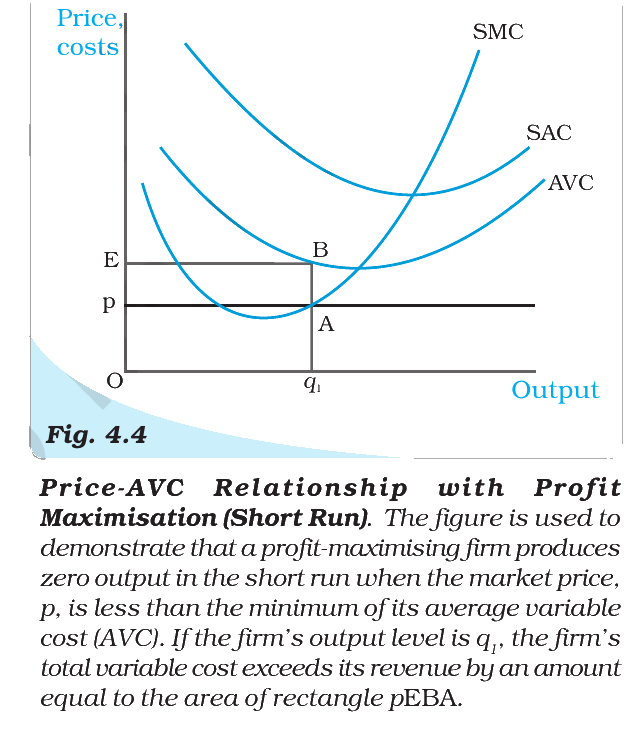
A firm’s reasoning in the short run, when the market price is below its AVC at every output, is given below with one step missing:
Step 1: At any positive output, TR = p × q is less than TVC = AVC × q.
Step 2: So, at any positive output, profit = TR − TVC − TFC is less than −TFC.
Step 3: ________
Step 4: So, the firm produces zero output.
Which of the following is the missing Step 3?
Answer & explanation
Correct answer: option 2
The correct answer is Option (2) → At zero output, TR and TVC are both zero, so profit is −TFC.
Step 3 must show what the firm earns if it produces nothing. With no output, it has no revenue and no variable cost, but it still pays its fixed cost. So its profit is −TFC, which is more than what it gets at any positive output.
Option (1) At zero output, TFC is also zero, so profit is zero. — Incorrect. Fixed cost does not depend on output. It is paid even at zero output, so profit is −TFC.
Option (2) At zero output, TR and TVC are both zero, so profit is −TFC. — Correct. This links Step 2 to Step 4.
Option (3) At zero output, price becomes greater than AVC. — Incorrect. The market price and the AVC curve do not change when the firm stops producing.
Option (4) At zero output, TR is zero but TVC is not, so the loss is larger. — Incorrect. Variable cost varies with output, so at zero output TVC is also zero.
NCERT (2026-27): “4.3.3 Condition 3 … Since output is zero, TR and TVC are zero as well. Hence, the firm’s profit at zero output is equal to – TFC. But, the area of rectangle OpAq1 is strictly less than the area of rectangle OEBq1. Hence, the firm’s profit at q1 is [(area EBAp)-TFC], which is strictly less than what it obtains by not producing at all. So, the firm will choose not to produce at all, and exit from the market.”
|