
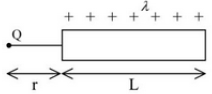
Charge Q is placed at a distance r from a uniformly charged rod having ‘λ’ as linear charge density. The electrostatic force between them (Length of rod = L) is:
Answer & explanation
Correct answer: option 2
The correct answer is Option (2) → \( \displaystyle\frac{kQ\lambda L}{r(r+L)} \)
The rod is not a point charge, so use Coulomb’s law on a small element and add the contributions by integration. From the figure, the near end of the rod is at distance r from Q and the far end at \( r+L \). Take an element of length \( dx \) at distance x from Q; it carries charge \( dq = \lambda\,dx \).
\( dF = \frac{kQ\,dq}{x^{2}} = \frac{kQ\lambda\,dx}{x^{2}} \)
All the elements lie on one line with Q, so every \( dF \) has the same direction and the magnitudes add:
\( F = kQ\lambda\int_{r}^{r+L}\frac{dx}{x^{2}} = kQ\lambda\left[-\frac{1}{x}\right]_{r}^{r+L} \)
\( \displaystyle F = kQ\lambda\left(\frac{1}{r}-\frac{1}{r+L}\right) = \frac{kQ\lambda L}{r(r+L)} \)