Which of the following explains the meaning of Treasury Bills?
Answer & explanation
Correct answer: option 2
The correct answer is Option (2) → They are also known as Zero Coupon Bonds
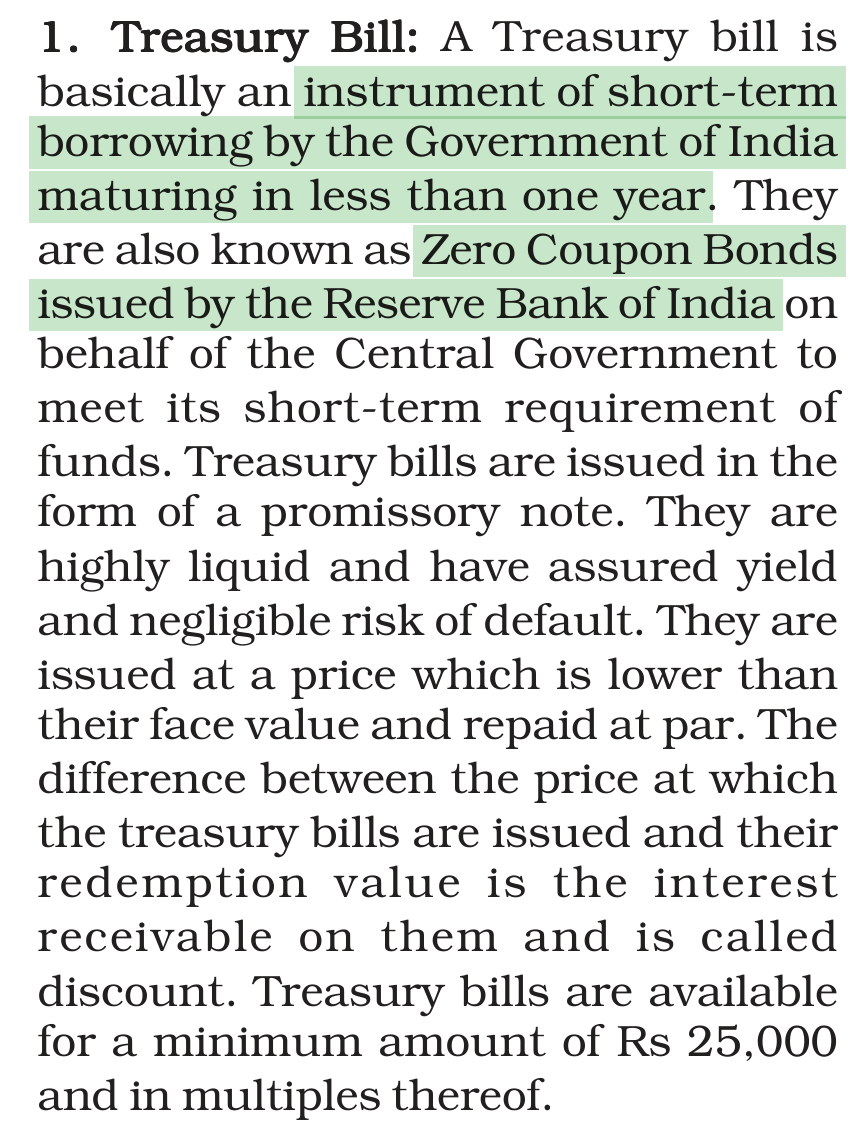
Option (1) It is issued by the State Bank of India — Incorrect. Treasury bills are issued by the Reserve Bank of India on behalf of the Central Government.
Option (2) They are also known as Zero Coupon Bonds — Correct. A treasury bill is a short-term borrowing instrument of the Government of India, maturing in less than one year. It pays no interest (coupon) during its life. Instead it is issued at a discount, below its face value, and repaid at face value. The difference is the investor’s return. A bond that pays no coupon is called a zero coupon bond.
Option (3) The minimum amount for a treasury bill is Rs. 100. — Incorrect. Treasury bills are available for a minimum amount of Rs. 25,000 and in multiples of it.
Option (4) It is a financial instrument for long term borrowing — Incorrect. It is a money market instrument for short-term borrowing, of less than one year.
Note: Although the chapter ‘Financial Markets’ was dropped from the NCERT textbooks during rationalisation, it has stayed in the NTA syllabus every year since 2022, except for 2025, and it is part of the syllabus again from 2026. This question is therefore based on the pre-rationalised NCERT, an extract from which is given below. This chapter left the NCERT textbook (2026-27) but never left NTA’s question paper. A few pages here can win you an easy five marks.
NCERT (Pre-rationalised Edition):
|