CUETMOCK
  • Pricing
  • Mentors
Log inStart freeStart free mocks→

First test, then trust

Try a free CUET mock test.

Join 5,00,000+ students who rehearsed exam day on the exact NTA screen before sitting CUET. On the web and on Android.

Start free mocks →Get the Android app
CUETMOCK

India's #1 CUET Mock Test Platform. Original NCERT-based questions on the exact NTA exam screen — trusted by 5,00,000+ students since CUET 2022.

Get it onGoogle PlayScan to download the CUETMOCK app

Mock tests

  • CUET mock test series
  • Commerce mocks
  • Humanities (Arts) mocks
  • Science mocks
  • Languages & GAT mocks
  • Free practice questions
  • Pricing

Resources

  • CUET exam guide
  • CUET syllabus
  • Universities accepting CUET
  • Expert blogs
  • News & notifications
  • Webinars & counselling
  • CUET score calculator
  • How we estimate your rank
  • FAQs

Company

  • About us
  • Our leadership & team
  • Our toppers
  • Mentors
  • For schools
  • Contact us
  • Terms
  • Privacy
  • Refund policy

Talk to us

+91 7696 6630 56info@cuetmock.comWhatsApp us

Our other platforms

  • JEE Mock — For IIT-JEE aspirants
  • NEET Mock — For NEET aspirants

Newsletter

Exam updates, study material and offers — no spam.

© 2026 NYC Ventures Pvt. Ltd.

701-702, Royal Business Park, Zirakpur, Punjab - 140603

  • Terms of use
  • Privacy policy
  • Refund policy
  • Contact us

iCUETMOCK is an independent preparation platform, not affiliated with the National Testing Agency (NTA). Always check exam details on the official NTA website.

  • Home
  • Mock tests
  • CUET guide
  • Pricing
  • Log in
Home/Practice questions/Physics
PhysicsDual Nature of Radiation and Matter

Why is the saturation current the same for the different frequencies…

Read the following passage and answer the questions.

A student uses a photocell to study how the stopping potential \(V_0\) depends on the frequency \(\nu\) of the incident light. She uses one source of light and puts a different filter in front of it for each frequency. The source stays at the same distance from the cell in every run. For each frequency, she records the photocurrent while she changes the potential of the collector plate. Figure (a) shows her results for three frequencies \(\nu_1\), \(\nu_2\) and \(\nu_3\). Each curve meets the potential axis at a different negative potential.

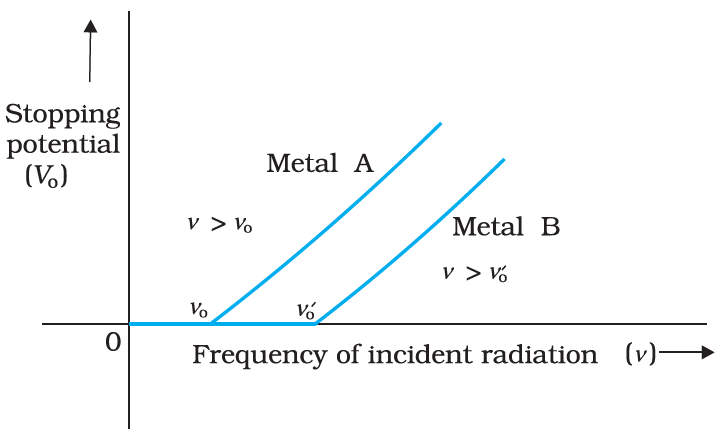
She then repeats the work with emitters of two different metals, A and B. For each metal she plots the stopping potential against the frequency and gets a straight line, as in figure (b). The line for metal A starts at the cut-off frequency \(\nu_0\), and the line for metal B starts at \(\nu_0^{\prime}\). In her experiment, \(\nu_0 = 5.0\times10^{14}\ \mathrm{Hz}\) and \(\nu_0^{\prime} = 8.0\times10^{14}\ \mathrm{Hz}\).
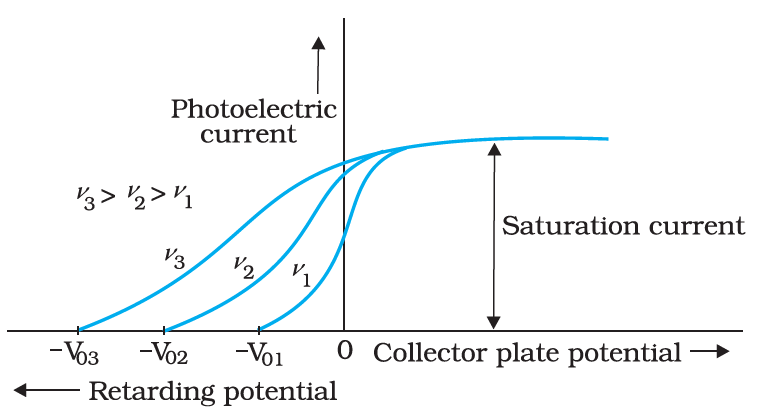
Figure for the question

(a)

Figure for the question

(b)

Why is the saturation current the same for the different frequencies in figure (a)?

Answer & explanation+

Correct answer: option 1

The correct answer is Option (1) → It depends upon the intensity of the incident light.

The saturation current flows when every emitted photoelectron reaches the collector. So it is set by the number of photoelectrons emitted per second. The passage says the light was adjusted to the same intensity at the various frequencies, and this gave the same value of the saturation current.

Option (1) It depends upon the intensity of the incident light. — Correct. The number of photoelectrons emitted per second is proportional to the intensity. With the same intensity for all three frequencies, the same number of electrons is emitted, so the saturation current is the same.

Option (2) It depends upon the frequency of the incident light. — Incorrect. The frequency changes the energy of the photoelectrons and hence the stopping potential. It does not change their number. Figure (a) shows three frequencies with one saturation value.

Option (3) It depends upon the work function of the metal. — Incorrect. The work function fixes the threshold frequency and the maximum kinetic energy. Above the threshold, the intensity sets the number of photoelectrons per second.

NCERT (2026-27):
Effect of Potential on Photoelectric Current – “… We can now repeat this experiment with incident radiation of the same frequency but of higher intensity I2 and I3 (I3 > I2 > I1). We note that the saturation currents are now found to be at higher values. This shows that more electrons are being emitted per second, proportional to the intensity of incident radiation.”

Advertisement

Practise more on Dual Nature of Radiation and Matter

Chapter-wise mocks on the real NTA exam screen, with solutions and your rank. Your first mocks are free.

Start free mocks →

Advertisement

Next questions

  1. 'कर्ण' शब्द का अर्थ नहीं है-Hindi · अनेकार्थी शब्द
  2. Malignant malaria is caused by:Biology · Human Health and Disease
  3. Which of the following explains the meaning of Treasury Bills?Business Studies · Financial Markets
  4. 64 small solid iron spheres of radius 'r' are melted to form a big sphere of radius R. If S and S' are surface areas of the small and the b…General Aptitude Test · Quantitative Reasoning
  5. The row below, read from left to right, is made up of letters, numbers and symbols. X 1 U U # E O 2 * J @ 8 O X 8 4 9 O J 3 P A Z 3 A S 4 H…General Aptitude Test · Verbal Reasoning
  6. Russia is a permanent member of the UN Security Council called...Political Science · Contemporary World Politics: International Organisations
  7. सूची-I से सूची-II का मिलान कीजिए: सूची-I सूची-II (A) जिसके दो पैर हैं। (I) निर्दय (B) जल में जन्मने वाला (II) अतीत (C) जिसके हृदय में दया न…Hindi · वाक्यांशों के लिए एक शब्द
  8. When DNA from different sources is cut by the same restriction enzymes, the resultant DNA fragments have the:Biology · Biotechnology -Principles and Processes
  9. The word ‘patronage’, as used in the passage, means:English · Comprehension - (Narrative / Factual)
  10. undersetx→∞lim(≤ft(∫limits_0^xe^x^2dx)^2)/(≤ft(∫limits_0^xe^2x^2dx))=Maths. Section B1 · Continuity and Differentiability