
Statement I: A stirred-tank bioreactor is usually cylindrical or has a curved base to facilitate the mixing of the reactor contents.
Statement II: In a stirred-tank bioreactor, the stirrer is used mainly to keep the culture at the optimum temperature.
Answer & explanation
Correct answer: option 1
The correct answer is Option (1) → Only statement I is correct.
The most common bioreactors are of the stirring type. A stirred-tank bioreactor is a vessel with a stirrer (impeller) turned by a motor. The stirrer keeps the cells, the nutrients and the oxygen evenly spread through the culture.
Statement I: A stirred-tank bioreactor is usually cylindrical or has a curved base to facilitate the mixing of the reactor contents. — True. A round vessel has no corners where the culture could stay still, so the contents mix well.
Statement II: In a stirred-tank bioreactor, the stirrer is used mainly to keep the culture at the optimum temperature. — False. The stirrer is for even mixing and oxygen availability. Temperature is kept right by a separate temperature control system.
NCERT Extract:
Obtaining the Foreign Gene Product – “… A stirred-tank reactor is usually cylindrical or with a curved base to facilitate the mixing of the reactor contents. The stirrer facilitates even mixing and oxygen availability throughout the bioreactor. Alternatively air can be bubbled through the reactor. … the bioreactor has an agitator system, an oxygen delivery system and a foam control system, a temperature control system, pH control system and sampling ports so that small volumes of the culture can be withdrawn periodically.”
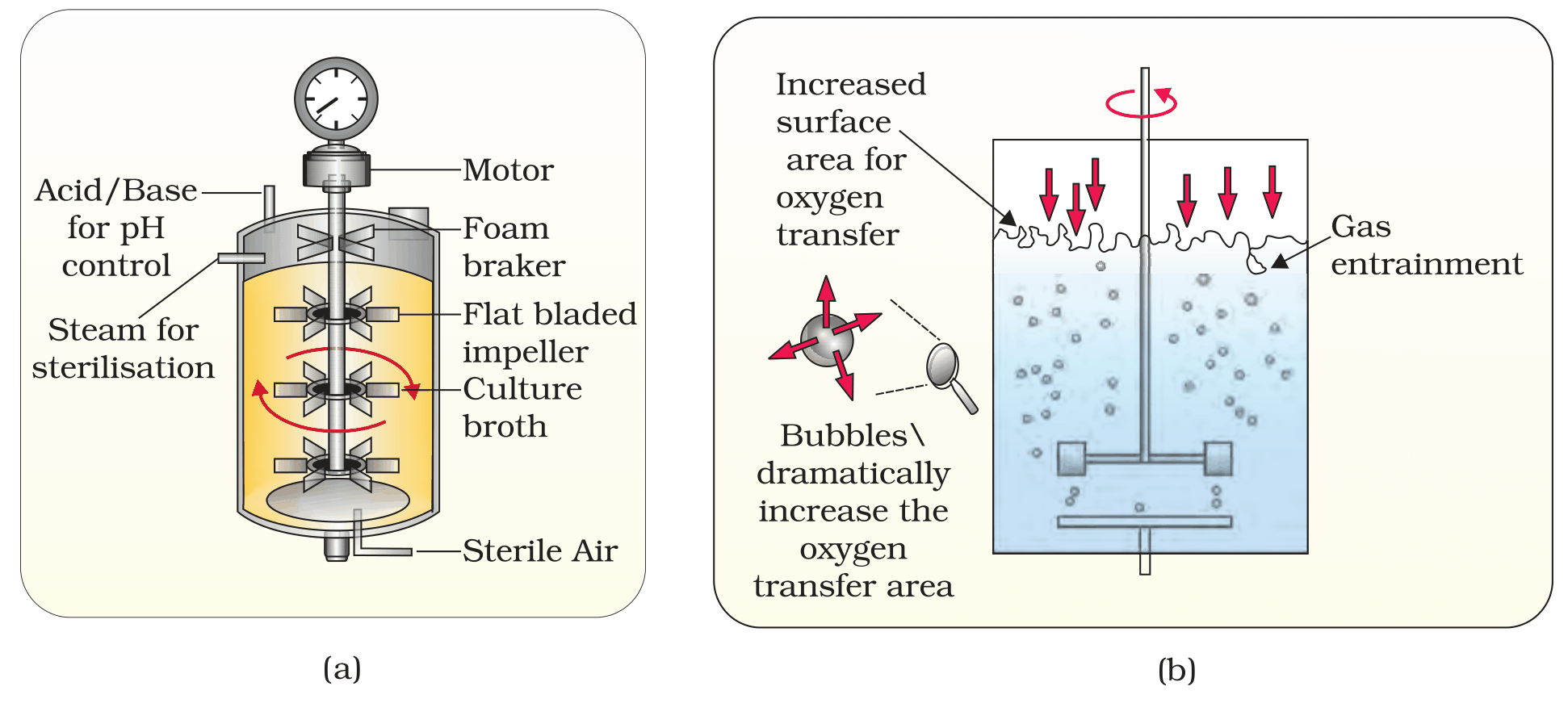
Figure 9.7 (a) Simple stirred-tank bioreactor; (b) Sparged stirred-tank bioreactor through which sterile air bubbles are sparged