
The squares \( S_1 \) and \( S_2 \) are shown below with the charges arranged at their corners.
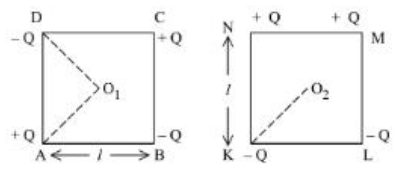
What is the relation between electric potentials \( V_1 \) and \( V_2 \) at the centres of the squares \( S_1 \) and \( S_2 \)?
Answer & explanation
Correct answer: option 4
The correct answer is Option (4) → \( V_1 = V_2 = 0 \)
Potential is a scalar, so by the superposition principle the potential at the centre is the sum of the potentials of the four corner charges, \( V = \frac{1}{4\pi\varepsilon_0}\sum\frac{q_i}{d} \). The centre of a square is at the same distance d from all four corners, so \( V = \frac{1}{4\pi\varepsilon_0 d}\sum q_i \), which depends only on the total charge.
\( S_1 \): \( (+Q) + (-Q) + (+Q) + (-Q) = 0 \Rightarrow V_1 = 0 \)
\( S_2 \): \( (+Q) + (+Q) + (-Q) + (-Q) = 0 \Rightarrow V_2 = 0 \)
Hence \( V_1 = V_2 = 0 \).