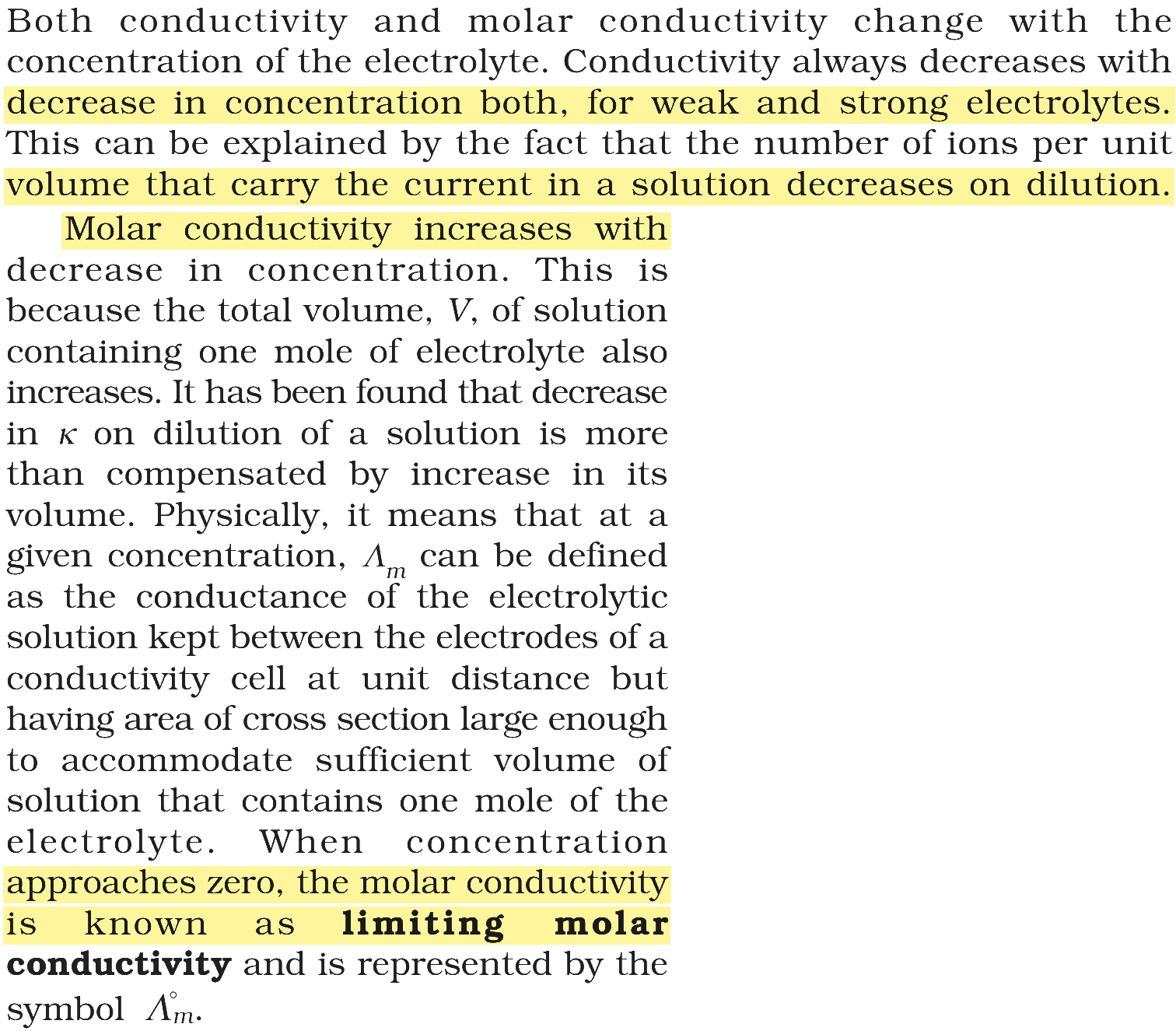
Which of the following statements are correct?
(A) On dilution, conductivity of all the electrolytes decreases.
(B) On dilution, the number of ions per unit volume decreases.
(C) Molar conductivity increases with dilution.
(D) Limiting molar conductivity is the conductivity at a very high concentration.
Choose the correct answer from the options given below.
Answer & explanation
Correct answer: option 1
The correct answer is Option (1) → (A), (B) and (C) only
Two different quantities change on dilution. Conductivity (κ) is the conductance of a unit volume of solution, so it depends on how many ions there are in that volume. Molar conductivity (\( \Lambda_m = \kappa V \)) is the conductance of the whole volume that contains one mole of electrolyte, so it depends on how freely that mole of electrolyte carries current.
(A) On dilution, conductivity of all the electrolytes decreases. — Correct. Conductivity decreases with decrease in concentration for both weak and strong electrolytes.
(B) On dilution, the number of ions per unit volume decreases. — Correct. This is the reason for (A): fewer ions in each unit volume carry the current.
(C) Molar conductivity increases with dilution. — Correct. On dilution the volume V containing one mole increases, and this more than compensates for the fall in κ; for strong electrolytes the ions also move more freely, and weak electrolytes dissociate more.
(D) Limiting molar conductivity is the conductivity at a very high concentration. — Incorrect. The limiting molar conductivity, \( \Lambda_m^{\circ} \), is the molar conductivity as the concentration approaches zero (infinite dilution), not at a high concentration, and it is a molar conductivity, not a conductivity.
NCERT (2026-27 edition):
Variation of Conductivity and Molar Conductivity with Concentration