
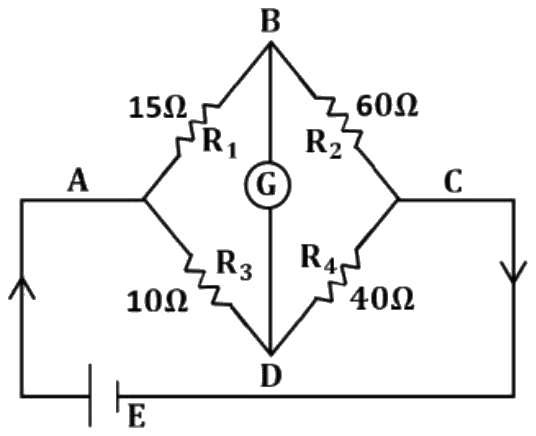
The figure shows a Wheatstone bridge circuit arrangement with a galvanometer G of resistance 5 Ω to detect the presence of current. The ratio of heat dissipated across four resistors, \( R_1 \), \( R_2 \), \( R_3 \), and \( R_4 \) respectively, is:
Answer & explanation
Correct answer: option 2
The correct answer is Option (2) → 1 : 4 : 1.5 : 6
Check the balance of the bridge first:
\( \displaystyle \frac{R_1}{R_2} = \frac{15}{60} = \frac{1}{4} \qquad \frac{R_3}{R_4} = \frac{10}{40} = \frac{1}{4} \)
The ratios are equal, so the bridge is balanced, B and D are at the same potential and the galvanometer carries no current. The same current \( I_1 \) flows through \( R_1 \) and \( R_2 \), and the same current \( I_2 \) through \( R_3 \) and \( R_4 \).
The two arms are in parallel across the cell, so the currents are inversely proportional to the arm resistances:
\( R_1 + R_2 = 75\,\Omega \)
\( R_3 + R_4 = 50\,\Omega \)
\( \displaystyle \frac{I_1}{I_2} = \frac{50}{75} = \frac{2}{3} \)
The heat dissipated in each resistor is proportional to \( I^{2}R \). Taking \( I_1 = 2 \) and \( I_2 = 3 \) units:
\( H_1 : H_2 : H_3 : H_4 = (2^{2}\times15) : (2^{2}\times60) : (3^{2}\times10) : (3^{2}\times40) \)
\( = 60 : 240 : 90 : 360 = 1 : 4 : 1.5 : 6 \)