Motivating Employees in Tata Steel
In Tata Steel several initiatives have been taken to further improve the motivation levels and participation in the decision making process of the officers, greater impetus to training through a formalised system of a personal development programme, talent review and job rotation systems, compensation linked to the performance management system, formal rewards and recognition systems, knowledge management systems linked with appraisals, leadership opportunities in quality circles, continuous improvement and value engineering programmes and an extremely transparent and credible multi-path communication system to address queries and concerns of all employees through various dialogues both formal and online, with such tools as video conferencing, ‘MD Online’, special dialogues with senior management, meetings, conferences and seminars. These initiatives have helped to build a homogeneous and focused team in Tata Steel, increasing motivation and binding to the vision of the company and spurred employees to deliver targets on a participatory management basis leading to ownership of processes. Tata Steel is a company that actively promotes freedom to work, freedom to innovate and even the freedom to fail. It is a nimble, fast, modern and forward-looking company on a strong growth path. The company has undergone a revolutionary change in terms of its production facilities and the technology in the manufacturing process. These changes have resulted in creating greater opportunities for taking up newer challenges for young recruits work and for performance based on IT enabled systems and high levels of automation. These have led to making the company one of the lowest cost producers of steel and the only Indian company to be recognised by the World Steel Dynamics as one of the top most ‘World Class’ steel makers. Tata Steel hopes not only to consolidate but better its leadership by robust leadership development systems that have seen the company create many CEOs for other companies.
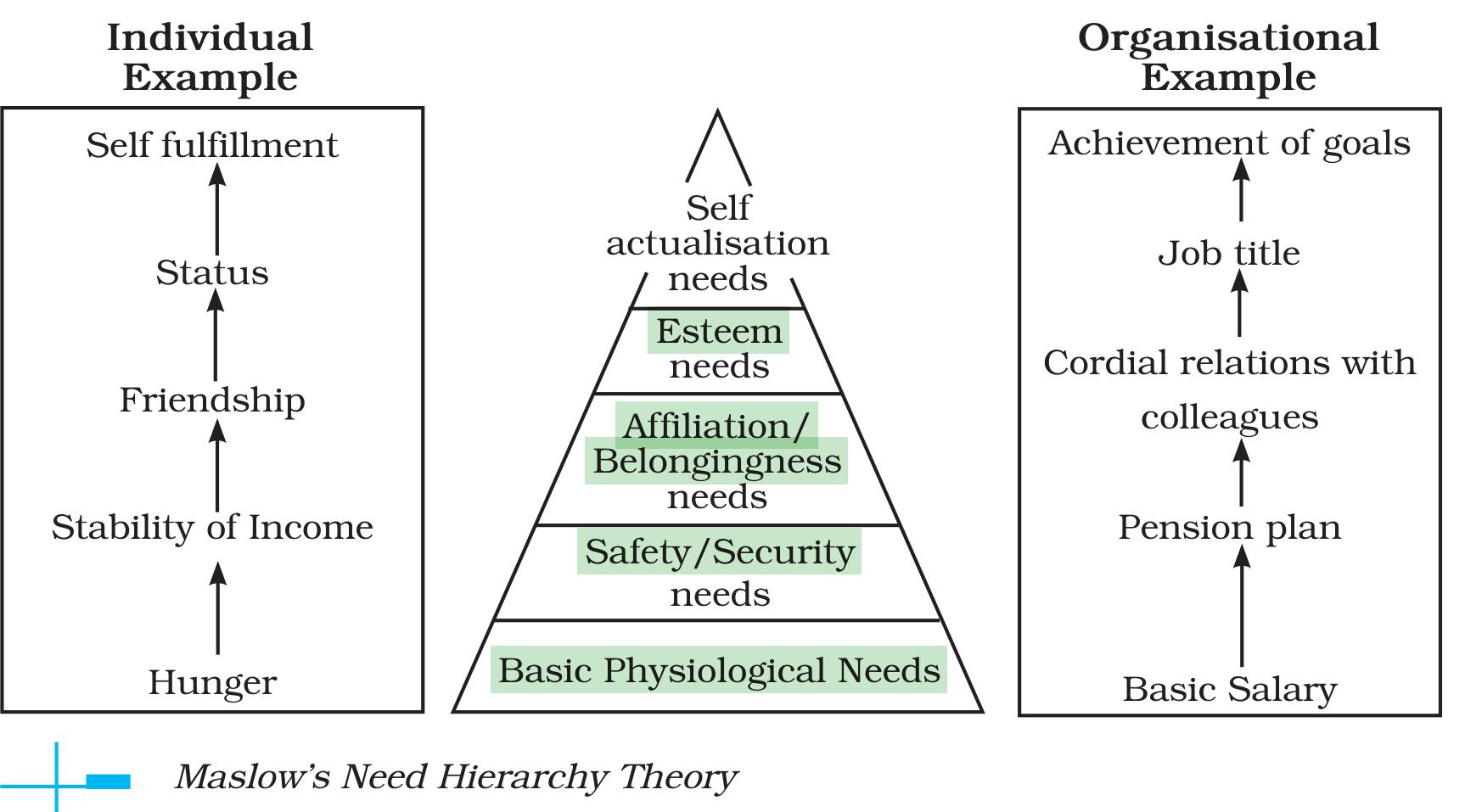
Following are the employees’ needs in order that are being fulfilled by Tata Steel according to Maslow’s need hierarchy theory:
Choose the correct answer from the options given below:
Answer & explanation
Correct answer: option 2
The correct answer is Option (2) → Physiological Needs, Security Needs, Affiliation Needs and Esteem Needs
Option (1) Physiological Needs, Security Needs, Esteem Needs and Affiliation Needs — Incorrect. Esteem is placed before affiliation. In Maslow’s order, the need to belong comes before the need for status and recognition.
Option (2) Physiological Needs, Security Needs, Affiliation Needs and Esteem Needs — Correct. Maslow’s theory arranges needs from the lowest to the highest: physiological, safety or security, affiliation or belonging, esteem, and self-actualisation. A higher need motivates a person only after the needs below it are largely met. At Tata Steel, pay linked to performance meets the lower needs, a focused team meets the need to belong, and formal rewards and recognition meet the need for esteem.
Option (3) Security Needs, Physiological Needs, Affiliation Needs and Esteem Needs — Incorrect. Physiological needs such as food and shelter are the most basic, so they come before security.
Option (4) Esteem Needs, Security Needs, Physiological Needs, and Affiliation Needs — Incorrect. The order is jumbled. Esteem is a higher need and cannot come first.
Note: The passage is the NCERT box ‘Motivating Employees in Tata Steel’ from the chapter ‘Directing’, which has been reproduced by NTA in the exam. NCERT (2026-27 Edition): “Maslow’s Need Hierarchy Theory … His theory was based on human needs. He felt that within every human being, there exists a hierarchy of five needs. These are:
|