
A company manufactures two types of cardigons: type A and type B. It costs ₹360 to make a type A cardigon and ₹120 to make a type B cardigon. The company can make atmost 300 cardigons and spend atmost ₹72000 a day. The number of cardigons of type B cannot exceed the number of cardigons of type A by more than 200. The company makes a profit of ₹100 for each cardigon of type A and ₹50 for every cardigon of type B. Formulate this problem as a linear programming problem to maximise the profit of the company. Solve it graphically and find maximum profit.
Answer & explanation
Correct answer: option 3
The correct answer is Option (3) → ₹22500
Let x cardigons of type A and y cardigons of type B be manufactured per day by the company, then profit P (in ₹) = $100x + 50y$.
Hence, the problem can be formulated as an L.P.P. as follows:
Maximize $P = 100x + 50y$ subject to the constraints
$360x + 120y ≤ 72000$ i.e. $3x + y ≤ 600$ (investment constraint)
$x + y ≤ 300$ (capacity constraint)
$y ≤ x + 200$ (type B constraint)
$x ≥ 0, y ≥ 0$ (non-negativity constraints)
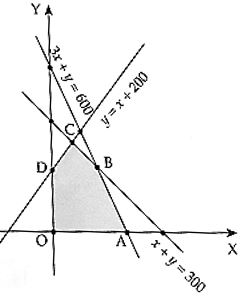
Draw the lines $3x + y = 600, x + y = 300$ and $y = x + 200$ and shade the region satisfied by the above inequalities.
The shaded portion OABCD shows the feasible region, which is bounded.
The corner points of the feasible region are O (0, 0), A (200, 0), B(150, 150), C (50, 250) and D(0, 200).
The values of P at the corner points are:
at $O(0, 0), P = 100×0 + 50×0 = 0;$
at $A (200, 0),P = 100×200+ 50×0 = 20000;$
at $B(150, 150),P = 100×150 + 50×150 = 22500;$
at $C (50, 250), P = 100×50 + 50×250 = 17500;$
at $D(0,200),P = 100×0 + 50×200 = 10000$.
We note that the value of P is maximum at the point B.
Hence, maximum profit = ₹22500 by manufacturing 150 cardigons of type A and 150 cardigons of type B.