
In a certain code:
‘A – B’ means ‘A is the wife of B’,
‘A ÷ B’ means ‘A is the brother of B’,
‘A + B’ means ‘A is the daughter of B’,
‘A × B’ means ‘A is the son of B’.
Which symbol should come in place of the question mark (?) in the expression P + Q – R ? S – T so that Q is the daughter-in-law of T?
Answer & explanation
Correct answer: option 1
The correct answer is Option (1) → ×
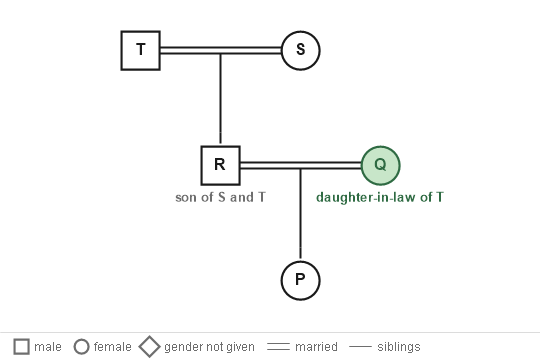
A daughter-in-law is the wife of one’s son. So Q, the wife of R, is T’s daughter-in-law only if R is T’s son.
P + Q: P is the daughter of Q
Q – R: Q is the wife of R, so R is male
S – T: S is the wife of T
R must be the son of T; as S is T’s wife, this means R is the son of S, that is R × S
With × the expression reads: R is the son of S and T, and Q, the wife of R, is T’s daughter-in-law.
Why the other options are incorrect
Option (2) + — Incorrect. R + S makes R a daughter, but Q – R says R is Q’s husband.
Option (3) – — Incorrect. R – S makes R the wife of S, but S is a woman (T’s wife) and R is Q’s husband.
Option (4) ÷ — Incorrect. R ÷ S makes R the brother of T’s wife, so R is T’s brother-in-law, not T’s son, and Q is not T’s daughter-in-law.