


CUET Preparation Today
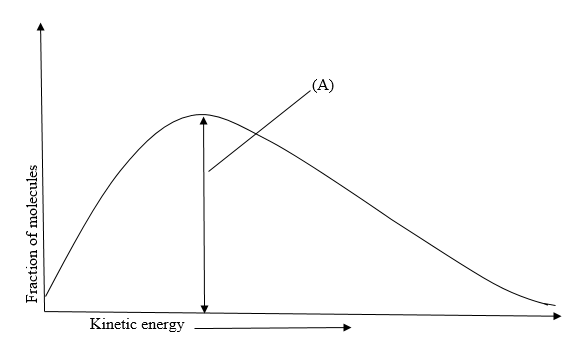
\(A\) in the following graph is:
|
Threshold energy Most probable kinetic energy Effective collision Temperature coefficient |
Most probable kinetic energy |
The correct answer is option 2. Most probable kinetic energy. The most probable kinetic energy of particles in a gas refers to the kinetic energy that corresponds to the most probable speed (the speed at which the greatest number of particles in the gas is moving). The most probable speed \(v_{mp}\) for particles in an ideal gas can be derived from the Maxwell-Boltzmann distribution and is given by: \(v_{mp} = \sqrt{\frac{2k_B T}{m}}\) where: \(k_B\) is the Boltzmann constant \((1.38 \times 10^{-23} \, \text{J/K})\), \(T\) is the absolute temperature in kelvins, \(m\) is the mass of a gas particle. The kinetic energy \(E_k\) of a particle is given by: \(E_k = \frac{1}{2}mv^2\) Substituting the most probable speed \(v_{mp}\) into the kinetic energy equation: \(E_{mp} = \frac{1}{2}m \left(\sqrt{\frac{2k_B T}{m}}\right)^2\) Simplifying: \(E_{mp} = \frac{1}{2}m \cdot \frac{2k_B T}{m}\) \(E_{mp} = k_B T\) This result indicates that the most probable kinetic energy is directly proportional to the temperature \(T\) of the gas. The most probable kinetic energy is represented by a peak on the Maxwell-Boltzmann energy distribution graph. This graph shows the distribution of kinetic energy in a gas as a fraction of molecules versus kinetic energy. The peak represents the energy that the maximum number of reactant molecules have at a given temperature. As temperature increases, the distribution curve changes in the following ways: Spreads and flattens, Increases the most probable kinetic energy, Shifts the peak to the right, Increases the fraction of higher-energy molecules, and Decreases the fraction of lower-energy molecules.
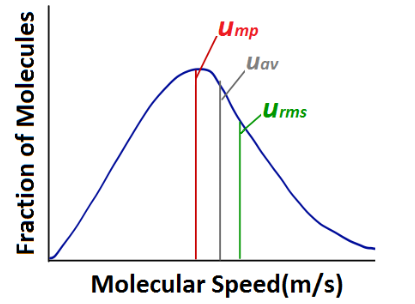
When analyzing a diagram of the distribution of molecular speeds, there are several commonly used terms to be familiar with. The most probable speed \((u_{mp})\) is the speed of the largest number of molecules, and corresponds to the peak of the distribution. The average speed \((u_{av})\) is the mean speed of all gas molecules in the sample. The root-mean-square \((rms)\) speed \((u_{rms})\) corresponds to the speed of molecules having exactly the same kinetic energy as the average kinetic energy of the sample. |