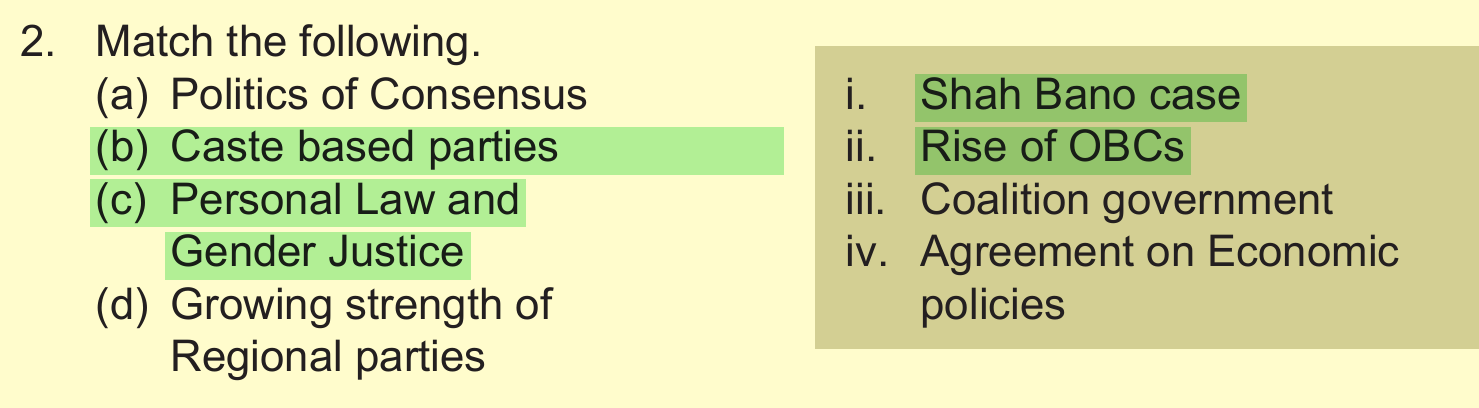
Match List-I with List-II
| List-I | List-II |
| (A) Personal Law and Gender Justice | (I) Rise of OBCs |
| (B) Era of Coalitions | (II) 2014 |
| (C) Caste-based parties | (III) Shah Bano case |
| (D) 16th Lok Sabha Elections | (IV) 1989 |
Choose the correct answer from the options given below:
Answer & explanation
Correct answer: option 4
The correct answer is Option (4) → (A)-(III), (B)-(IV), (C)-(I), (D)-(II)
(A) Personal Law and Gender Justice — this matches (III) Shah Bano case.
(B) Era of Coalitions — this matches (IV) 1989.
(C) Caste-based parties — this matches (I) Rise of OBCs.
(D) 16th Lok Sabha Elections — this matches (II) 2014.
NCERT (2026-27): “Alliance politics … Thus, with the elections of 1989, a long phase of coalition politics began in India. Since then, there have been eleven governments at the Centre, all of which have either been coalition governments or minority governments supported by other parties, which did not join the government.… Lok Sabha Elections (2004-2019) … BJP under the leadership of Narendra Modi got a clear majority in 16th Lok Sabha elections held in 2014. BJP won 282 seats on its own, becoming the first party to gain single party majority after 30 years.…”
|