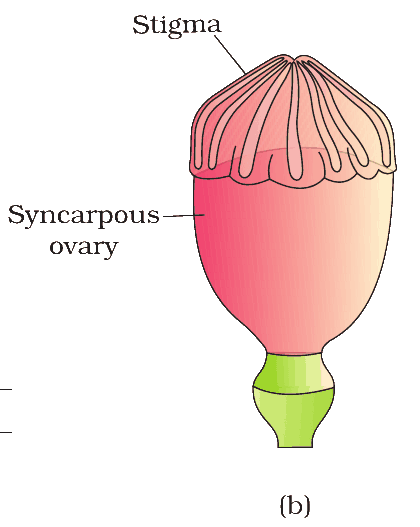
The gynoecium, the female reproductive part of the flower, shows wide variation in nature and flower in Papaver is:
Answer & explanation
Correct answer: option 4
The correct answer is Option (4) → Multicarpellary, syncarpous with fused stigmas
The gynoecium is the female part of a flower. It may have one carpel (monocarpellary) or many (multicarpellary). Many carpels may be joined together (syncarpous) or may be free (apocarpous). Papaver, the poppy, has a pistil made of several carpels joined into one ovary.
(1) Multicarpellary, apocarpous — Incorrect. In an apocarpous gynoecium the carpels are free, as in Michelia.
(2) Monocarpellary — Incorrect. This means a single carpel. Papaver has many.
(3) Multicarpellary, syncarpous with free stigmas — Incorrect. The carpels are joined, but the stigmas are not free. They form one disc on top of the ovary, as the figure shows.
(4) Multicarpellary, syncarpous with fused stigmas — Correct. Many carpels are joined into one ovary, and the stigmas are fused into a single disc.
NCERT Extract:
The Pistil, Megasporangium (ovule) and Embryo sac – “… The gynoecium represents the female reproductive part of the flower. The gynoecium may consist of a single pistil (monocarpellary) or may have more than one pistil (multicarpellary). When there are more than one, the pistils may be fused together (syncarpous) (Figure 1.7b) or may be free (apocarpous) (Figure 1.7c).”