
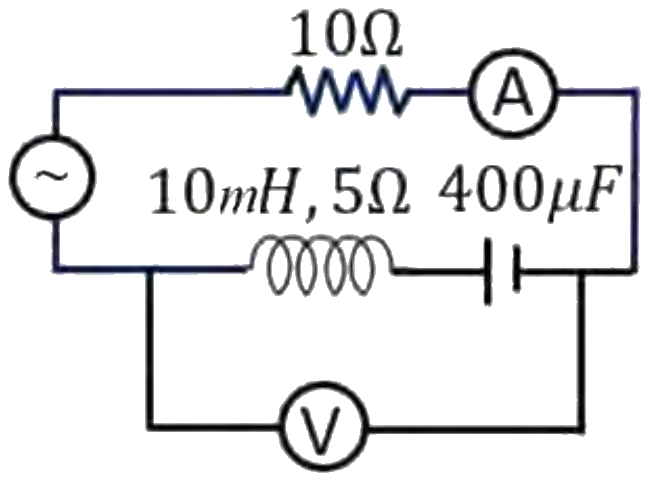
In the circuit shown in the figure, the ac source gives a voltage of \( V = 10\cos(500t) \). The ammeter reading will be:
Answer & explanation
Correct answer: option 3
The correct answer is Option (3) → \( \frac{\sqrt{2}}{3}\,\mathrm{A} \)
The \( 10\,\Omega \) resistor, the ammeter, the coil (\( 10\,\mathrm{mH} \) with \( 5\,\Omega \) resistance) and the capacitor are in one series loop. The voltmeter is ideal and draws no current. An ammeter reads the rms value of the current. From \( V = 10\cos(500t) \): \( V_0 = 10\,\mathrm{V} \) and \( \omega = 500\,\mathrm{rad\,s^{-1}} \).
\( \displaystyle X_L = \omega L = 500 \times 10\times10^{-3} = 5\,\Omega \)
\( \displaystyle X_C = \frac{1}{\omega C} = \frac{1}{500 \times 400\times10^{-6}} = 5\,\Omega \)
Since \( X_L = X_C \), the circuit is at resonance and the reactances cancel. The impedance is then the total resistance.
\( \displaystyle Z = R = 10 + 5 = 15\,\Omega \)
\( \displaystyle I_{\mathrm{rms}} = \frac{V_0/\sqrt{2}}{Z} = \frac{10/\sqrt{2}}{15} = \frac{\sqrt{2}}{3}\,\mathrm{A} \)