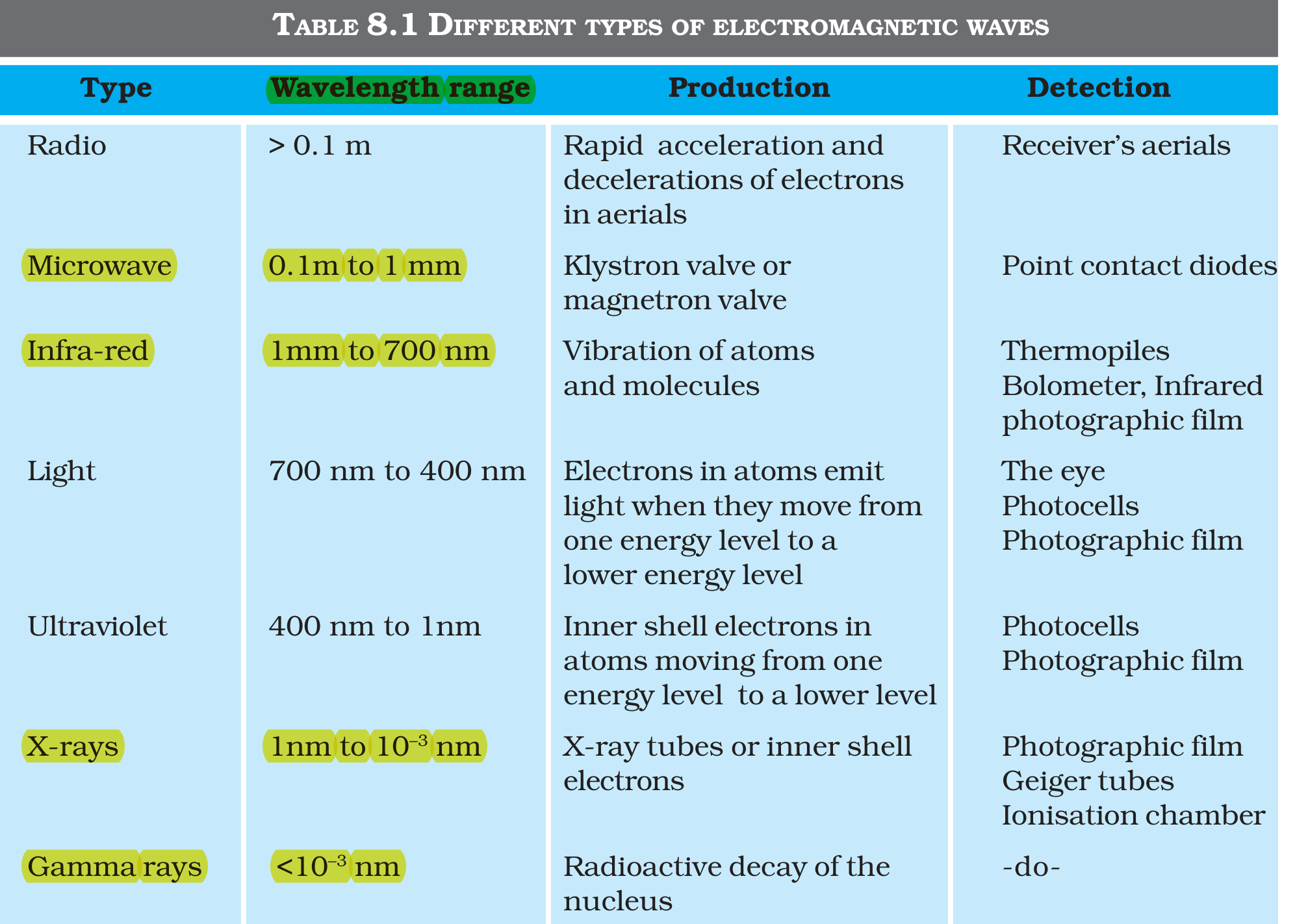
Match List-I with List-II
| List-I | List-II | ||
|---|---|---|---|
| EM WAVES | WAVELENGTH | ||
| (A) | Gamma rays | (I) | \( \lt 10^{-3} \) nm |
| (B) | Infra-red radiations | (II) | \( 1 \) nm to \( 10^{-3} \) nm |
| (C) | Microwaves | (III) | \( 1 \) mm to \( 700 \) nm |
| (D) | X-rays | (IV) | \( 0.1 \) m to \( 1 \) mm |
Choose the correct answer from the options given below:
Answer & explanation
Correct answer: option 1
The correct answer is Option (1) → (A) - (III), (B) - (I), (C) - (IV), (D) - (II)
Note: The given answer is as per the official NTA Answer Key. However, there seems to be a mistake in the question. The answer given by NTA matches gamma rays and infra-red radiation with each other’s wavelength ranges; the correct answer is Option (2), as explained below.
In order of decreasing wavelength: radio waves, microwaves, infra-red, visible (about 700 nm to 400 nm), ultraviolet, X-rays, gamma rays.
(A) Gamma rays — this matches (I) less than \( 10^{-3} \) nm, the shortest wavelengths.
(B) Infra-red radiations — this matches (III) 1 mm to 700 nm, just beyond red light.
(C) Microwaves — this matches (IV) 0.1 m to 1 mm, between radio waves and infra-red.
(D) X-rays — this matches (II) 1 nm to \( 10^{-3} \) nm, between ultraviolet and gamma rays.
This is Option (2). The NTA key, Option (1), pairs (A) with (III) and (B) with (I), interchanging these two; its pairs (C)-(IV) and (D)-(II) are correct.
NCERT (2026-27):
Gamma Rays – …