
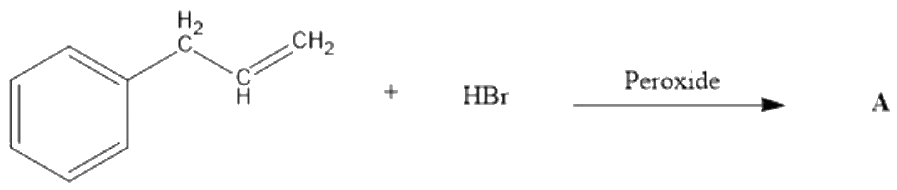
Write the major product A in the following chemical reaction.
Answer & explanation
Correct answer: option 2
The correct answer is Option (2) → 1-bromo-3-phenylpropane
HBr adds to an unsymmetrical alkene in two different ways, depending on whether a peroxide is present:
Without peroxide (ionic mechanism): \( \ce{H^+} \) adds first to give the more stable carbocation, so Br ends up on the more substituted carbon: Markovnikov addition.
With peroxide (free radical mechanism, peroxide or Kharasch effect): the peroxide gives radicals that take H from HBr and form a Br• radical. Br• adds first, to the terminal \( \ce{CH2} \), to give the more stable (secondary) carbon radical. That radical then takes H from HBr, so Br ends up on the less substituted carbon: anti-Markovnikov addition.
Only HBr shows the peroxide effect; HCl and HI give the Markovnikov product even with peroxide.
The alkene here is 3-phenylprop-1-ene (allylbenzene), \( \ce{C6H5-CH2-CH=CH2} \). With peroxide the radical chain runs as follows:
RO–OR → 2RO• (on heating)
RO• + HBr → ROH + Br•
C6H5–CH2–CH=CH2 + Br• → C6H5–CH2–C•H–CH2Br
C6H5–CH2–C•H–CH2Br + HBr → C6H5–CH2–CH2–CH2Br + Br•
The Br• formed in the last step starts the next cycle. The net reaction is:
\( \displaystyle \ce{C6H5-CH2-CH=CH2 + HBr} \xrightarrow{\text{peroxide}} \ce{C6H5-CH2-CH2-CH2Br} \)
So the major product A is 1-bromo-3-phenylpropane.
Why the other options are incorrect
Option (1) 2-bromo-1-phenylpropane — Incorrect. Here Br is on the middle carbon, the more substituted carbon of the double bond. This is the Markovnikov product, formed when HBr adds in the absence of peroxide.
Option (3) 1-bromo-1-phenylpropane — Incorrect. Br is on the carbon next to the ring, which is not part of the double bond. Addition of HBr across C=C puts Br on one of the two double-bond carbons only.
Option (4) 3-(2-bromophenyl)prop-1-ene — Incorrect. The double bond is untouched and Br is on the ring. Putting Br on the ring is an electrophilic substitution with \( \ce{Br2/FeBr3} \), not an addition of HBr.
Note: The same/similar question has been asked in different years by NTA as per the details given below:
| 2026 | 2025 | 2024 | 2023 | 2022 |
|---|---|---|---|---|
| 06-06 S1 20-05 S2 | – | – | – | – |