
The figure shows the plot of ln k against 1/T for a reaction, according to the Arrhenius equation.
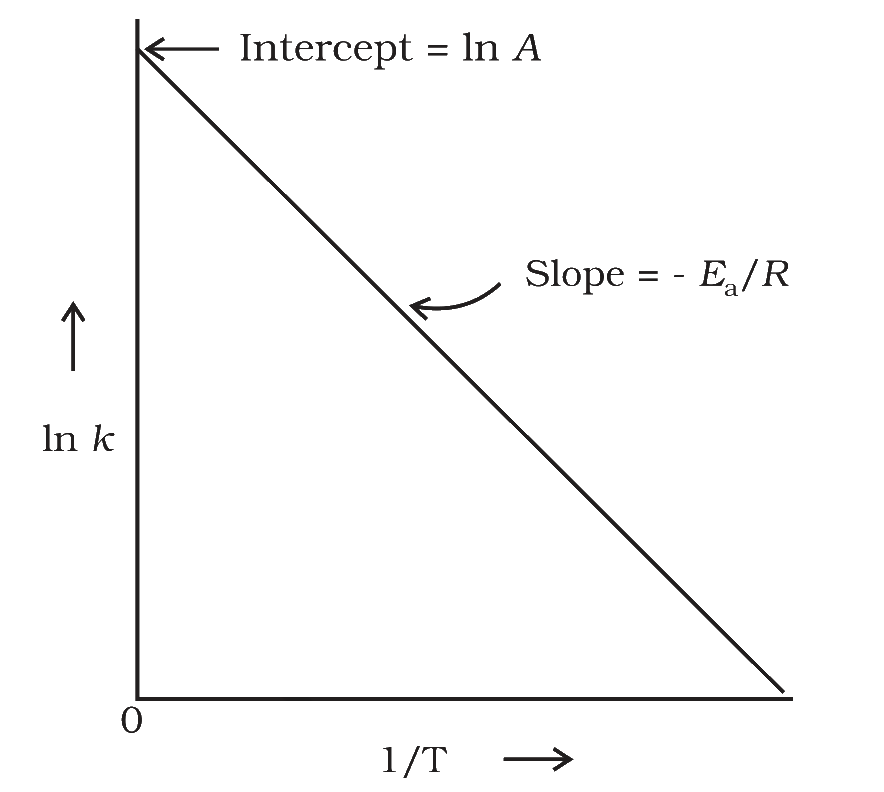
Two reactions have the same Arrhenius factor (A), but different activation energies. On these axes, the line of the reaction with the higher activation energy is:
Answer & explanation
Correct answer: option 2
The correct answer is Option (2) → steeper, and meets the ln k axis at the same point
The figure marks the two features of the line: the slope = −Ea/R and the intercept = ln A.
\( \displaystyle \ln k = -\frac{E_a}{R}\left(\frac{1}{T}\right) + \ln A \)
Slope — Steeper. The slope is −Ea/R, so a larger Ea gives a more negative slope. The line falls more sharply as 1/T increases.
Intercept — The same point. The line meets the ln k axis at ln A. Both reactions have the same A, so both lines start from the same point on that axis.
Why the other options are incorrect
Option (1) less steep, and meets the ln k axis at the same point — Incorrect. A less steep line would mean a smaller Ea.
Option (3) steeper, and meets the ln k axis at a higher point — Incorrect. A higher point on the ln k axis would need a larger A; Ea does not change the intercept.
Option (4) less steep, and meets the ln k axis at a higher point — Incorrect. Both parts are wrong: Ea is larger and A is the same.
NCERT (2026-27 edition):
3.4 Temperature Dependence of the Rate of a Reaction – “The plot of ln k vs 1/T gives a straight line according to the equation (3.19) as shown in Fig. 3.10.” … “In Fig. 3.10, slope = – Ea/R and intercept = ln A. So we can calculate Ea and A using these values.”
\( \displaystyle \ln k = -\frac{E_a}{RT} + \ln A \qquad (3.19) \)
Fig. 3.10: A plot between ln k and 1/T