Salicylaldehyde can be prepared by treating phenol with
Answer & explanation
Correct answer: option 4
The correct answer is Option (4) → \(CHCl_3\) in the presence of aqueous NaOH
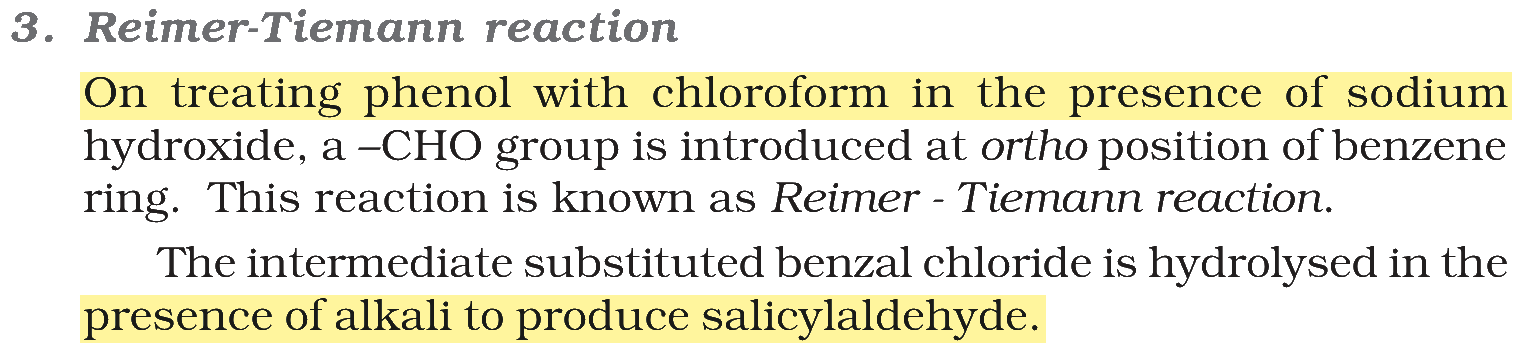
In alkaline solution phenol becomes the phenoxide ion, which is even more reactive than phenol towards electrophiles at the ortho and para positions. Heated with chloroform and aqueous sodium hydroxide (the Reimer-Tiemann reaction), it gives salicylaldehyde (2-hydroxybenzaldehyde) after acidification:
\( \displaystyle \ce{C6H5OH} \xrightarrow[\text{(ii) }\ce{H3O+}]{\text{(i) }\ce{CHCl3}\text{, aq. }\ce{NaOH}} o\text{-}\ce{HO-C6H4-CHO} \)
So salicylaldehyde is made by treating phenol with chloroform in the presence of aqueous NaOH.
Why the other options are incorrect
Option (1) \(CCl_4\) in presence of aqueous KOH — Incorrect. With carbon tetrachloride in place of chloroform, the group that enters the ring has one more chlorine, and hydrolysis gives a –COOH group: the product is salicylic acid, not the aldehyde.
Option (2) \(CO_2\) under pressure in the presence of sodium hydroxide solution. — Incorrect. This is Kolbe’s reaction: sodium phenoxide reacts with carbon dioxide to give salicylic acid:
\( \displaystyle \ce{C6H5O^-Na+} \xrightarrow[\text{(ii) }\ce{H+}]{\text{(i) }\ce{CO2}} o\text{-}\ce{HO-C6H4-COOH} \)
Option (3) \(NaNO_2\) and a few drops of concentrated \(H_2SO_4\) — Incorrect. Nitrous acid formed from these attacks the activated ring to give a nitrosophenol (mainly p-nitrosophenol); no –CHO group is introduced.
NCERT (2026-27 edition):
Reimer-Tiemann Reaction