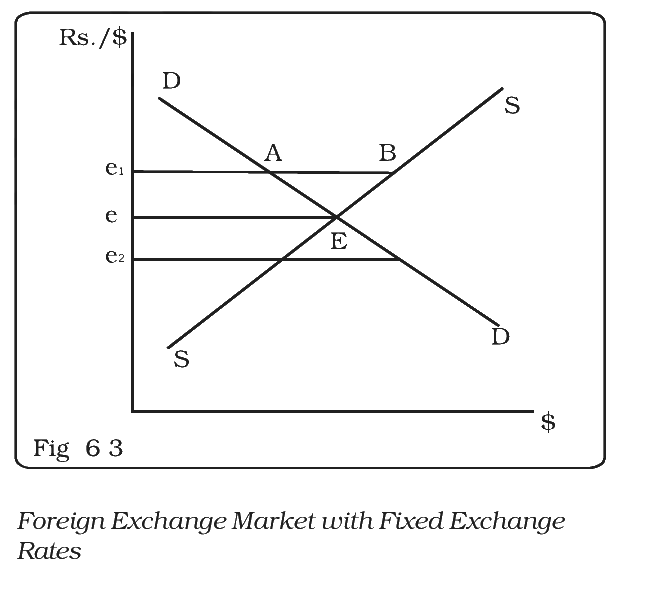
Assertion (A): When the government fixes the exchange rate above the market rate, the RBI’s foreign exchange holdings keep rising as long as it intervenes.
Reason (R): At a rate above the market rate, the supply of dollars exceeds the demand, and the RBI buys the excess dollars for rupees.
Answer & explanation
Correct answer: option 1
The correct answer is Option (1) → Both (A) and (R) are true and (R) is the correct explanation of (A).
Assertion (A): When the government fixes the exchange rate above the market rate, the RBI’s foreign exchange holdings keep rising as long as it intervenes. — True. The RBI keeps accumulating foreign exchange while it holds the rate.
Reason (R): At a rate above the market rate, the supply of dollars exceeds the demand, and the RBI buys the excess dollars for rupees. — True. At the higher rate there is an excess supply of dollars, which the RBI buys up.
Why R explains A?
To keep the higher rate, the RBI must take up the excess supply of dollars every time. Each purchase adds dollars to its holdings. So its reserves keep rising for as long as it intervenes.
NCERT (2026-27): “Fixed Exchange Rates … At this exchange rate, the supply of dollars exceeds the demand for dollars. The RBI intervenes to purchase the dollars for rupees in the foreign exchange market in order to absorb this excess supply which has been marked as AB in the figure. Thus, through intervention, the Government can maintain any exchange rate in the economy. But it will be accumulating more and more foreign exchange so long as this intervention goes on.”
|