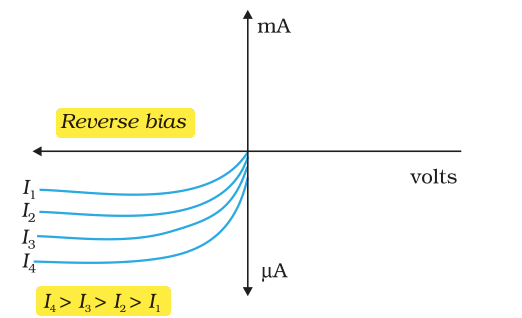
For a photodiode, the I-V characteristics for different illumination intensities \( I_1, I_2, I_3 \) and \( I_4 \) were plotted. Which of the following is correct?
Answer & explanation
Correct answer: option 2
The correct answer is Option (2) → \( I_4 \gt I_3 \gt I_2 \gt I_1 \)
A photodiode is used in reverse bias, where the current is the photocurrent produced by the light. The photocurrent is proportional to the intensity of the incident light, so the brighter the illumination, the larger the reverse current.
In the figure the reverse current is measured downwards (in μA). The curve of \( I_1 \) lies closest to the voltage axis, so it has the smallest current, and the curve of \( I_4 \) lies lowest, so it has the largest. Hence the intensities are in the order \( I_4 \gt I_3 \gt I_2 \gt I_1 \).
Note: This question is from the pre-rationalised NCERT book (2022-23). The topic was removed from the latest NCERT book (2026-27), and it also appears to be out of the CUET 2026 syllabus.
NCERT (Pre-rationalised edition, 2022-23):
Optoelectronic Junction Devices – “… A Photodiode is again a special purpose p-n junction diode fabricated with a transparent window to allow light to fall on the diode. It is operated under reverse bias. … The magnitude of the photocurrent depends on the intensity of incident light (photocurrent is proportional to incident light intensity).”